
Blog
FiiO EH11 Review — Headfonics

[ad_1]
Meldrick reviews the FiiO EH11, an affordable set of retro-inspired on-ear Bluetooth 6.0 headphones with LDAC decoding capability. They are currently priced at $29.99.
Disclaimer: I received this sample in exchange for my honest opinion. Headfonics is an independent website with no affiliate links or services. I want to thank FiiO for their support.
You can click here to learn more about the FiiO audio products previously reviewed on Headfonics.
This post follows our current scoring guidelines, which you can read in more detail here.

FiiO EH11 Review
Summary
The FiiO EH11 is an enjoyable and competitive wireless headphone for its price, with a trendy retro design, pleasing tuning, and Bluetooth 6.0 with LDAC for less than $50. Physical rotary controls are a tactile highlight, and the 1.5-hour charge time keeps daily logistics simple.
Pros
PEQ Functionality.
Intuitive control scheme.
Multi-Device Pairing.
Cons
No ANC.
Sub-par passive noise isolation.
FiiO may be better known for their DAC/AMPS and wired headphones like the K13 R2R and FT1, but this time they are entering the sub-$50 wireless headphone space with the EH11.
The EH11 is a proposition that is hard to ignore: with its charming retro flair, LDAC hi-res Bluetooth compatibility, and parametric EQ support, all for around $30.
Coming at a similar price point to the Anytime headphones released by FiiO under their SNOWSKY sub-brand, is the EH11 a true upgrade or just a nostalgic side-grade?
To find out, read my full thoughts and comparisons to competing budget on-ear headphones, the Anytime, Wind, and the Koss KPH30i below.

Features
At the core of the EH11 is a 40mm long-throw dynamic driver housed in a semi-open acoustic design, a combination that FiiO says reduces internal pressure buildup and promotes a more natural, spacious presentation compared to fully sealed alternatives.
Aesthetically, the EH11 leans into its retro identity through a pair of physical rotary knobs mounted on each of the wooden earcups, handling volume and track navigation with a satisfying tactile character that touch panels simply cannot replicate.
Connectivity is handled by Bluetooth 6.0 with LDAC support for up to 990kbps wireless transmission, alongside SBC and AAC.
Rounding out the feature set, the FiiO Control app unlocks a full parametric EQ, giving users precise, band-by-band control over the EH11’s sound signature beyond the included genre presets.
Design
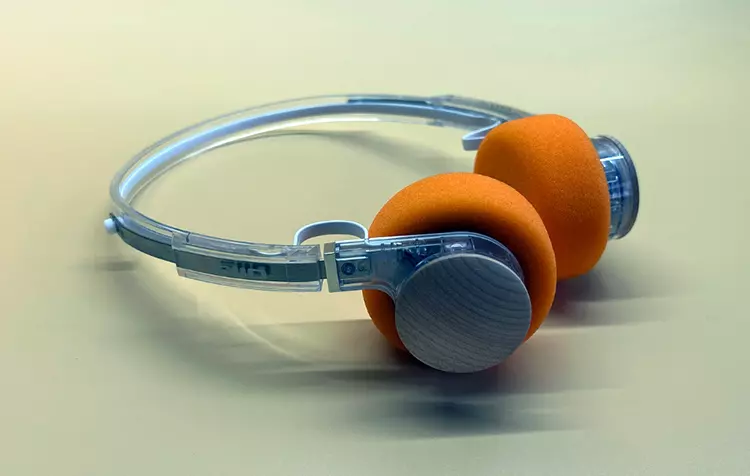
The EH11 comes in five different colors: Off-white, Cyan, Burgundy, Transparent Black, and the standard Transparent variant sent to me for review.
Even after taking just one look at the EH11, it’s difficult to ignore its resemblance to 80s-90s portable audio gear, a design motif that’s been steadily gaining steam with the emergence of Y2K-inspired aesthetic trends.
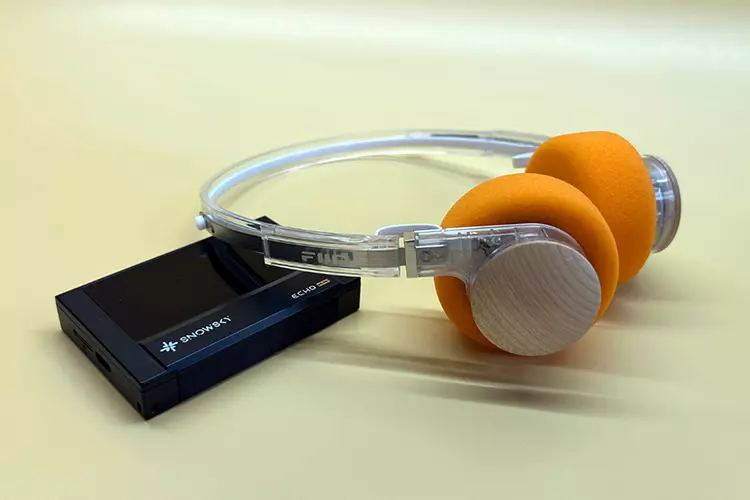
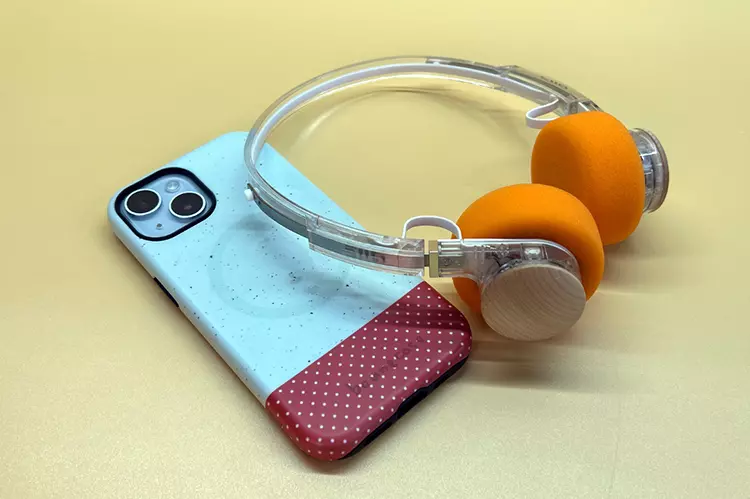
But its wooden earcups, transparent headband, visible spring steel sliders, and bright orange colored earpads blend the retro inspiration with more modern minimalist sensibilities, giving it a “retro-futuristic” appeal that translates nicely in daily usage.
The headphones are flanked with physical rotary knobs integrated into each earcup, handling volume and track navigation. This is a hardware choice that references vintage hi-fi ergonomics and allows confident blind operation.
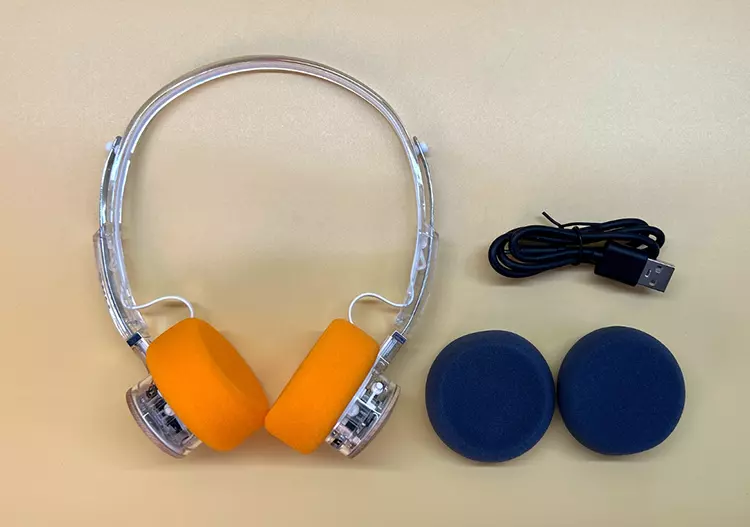
The foam earcups are replaceable and come in two colors in the box, adding practical longevity and easy personalization. The plastic headband, while impressively lightweight, does not inspire the same confidence as a thicker, full steel headband.
That said, for its price point and target audience, the EH11’s visual coherence and personality are genuinely commendable.
It’s a thoughtful design, clearly targeting younger or casual users who value both form and function. While not luxurious, it holds its own in terms of build quality and aesthetic cohesion at this price point.

Comfort & Isolation
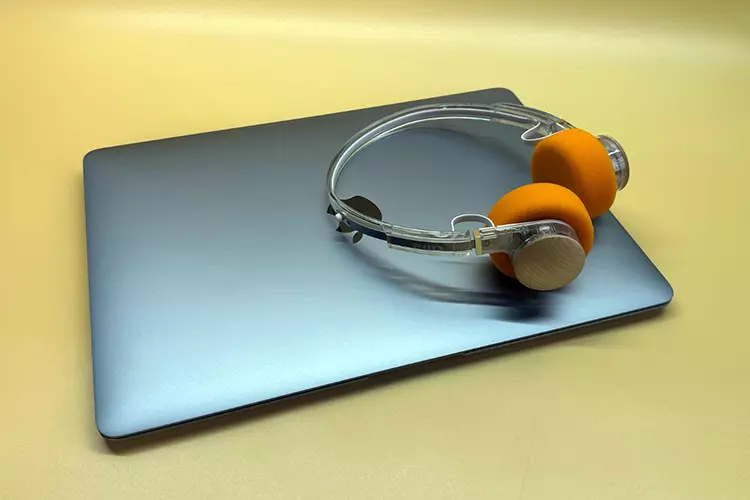
Coming in at a featherweight 92g, the EH11 is one of the lightest and most comfortable pieces of headgear I’ve tried.
The headband distributes weight evenly with no noticeable pressure points, and the foam earcups stay cooler over long sessions than the synthetic leather alternatives found on competing closed-back models.
Both prolonged stationary and on-the-go listening were a treat with the EH11. Its clamp force was just enough to stay steady on my head during walks, while avoiding any irritating pressure points on my skull.
Its lightweight plastic headband also did a good job spreading the weight of the headphones and all integrated electronics evenly across the headphones.
Even while turning the rotary knobs or pressing the singular button, the EH11 stayed planted on my head.
As a semi-open on-ear design with no ANC, passive isolation is predictably limited. Ambient conversations and environmental noise filter through with relative ease, and there is a small degree of sound leakage outward, making the EH11 less suited to quiet office or library environments.
During my office testing, background conversations were barely audible when I was playing music at a reasonable listening volume.
However, my music came off as a faint whisper to those right next to my desk. Users who require meaningful noise attenuation in their daily environment may find the lack of ANC a notable drawback at this price point.
Controls
The FiiO EH11 features a well-designed knob-based control layout that is shockingly intuitive.
Turning the knob on the right earcup clockwise increases the volume, and turning it anti-clockwise reduces the volume. The left earcup knob oversees triggering the next track and previous track functions.
My minor nitpick is how turning the left knob clockwise triggers the previous track, while turning it counterclockwise triggers the next track.
I personally find it more intuitive for the next track to be triggered by a clockwise motion, but it was not too difficult to get used to the EH11’s control scheme.
Both knobs have a tactile click after each rotation. I found this to be extremely helpful in determining whether I was able to trigger the command I intended.
The right earcup has a small action button in charge of play/pause controls, as well as triggering the voice assistant button with a double tap. The button has a tactile feel and is easy enough to press when needed, and discreet enough to stay out of the way to prevent mis-presses.
Software
The EH11 is managed through the FiiO Control app, available on both the Google Play Store and Apple App Store.
Compared to companion apps by brands like Sennheiser, FiiO’s implementation is quite barebones, but it offers some key features that let it stand out from the rest.
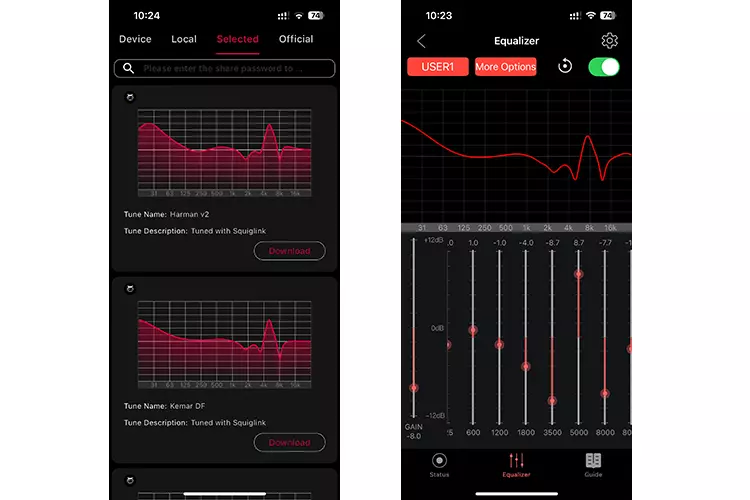
Upon pairing, the app surfaces controls for “Status” to show the active Bluetooth codec and battery level, “Equalizer” to set Parametric EQ settings, and “Guide” to bring up a digital copy of the user guide.
The presence of a 10-band parametric EQ is a significant feature for a pair of wireless headphones at this price point.
And for those such as myself who are not yet proficient at dialing the perfect Q values and gain settings, there are several community-uploaded EQ profiles that can be downloaded directly from the app’s “Selected” Equalizer menu.
These profiles range from standard industry targets like Harman V2 and diffused field, all the way to the frequency response of other headphones, such as the Koss KSC75.
During my review process, I found myself using community-uploaded EQ profiles for the bulk of my listening.
Battery Life
The EH11 is rated for up to 30 hours of continuous playback on a single charge, with a full recharge completed in approximately 1.5 hours via USB-C.
In practice, 30 hours translates to roughly two to four days of moderate commuter use before needing a top-up, a competitive figure at this price, though it falls short of the extraordinary battery life offered by some ANC-equipped competitors.
The 1.5-hour charge time is a genuine convenience advantage over rivals with comparable capacities that require two or more hours to replenish fully.
No quick charge feature is officially advertised, but the combination of strong total capacity and a fast recharge cycle means running out of power mid-day is an unlikely scenario in regular use. I never found myself anxious about battery level before heading out for the day.
Packaging & Accessories
The EH11 arrives in compact retail packaging with the headphones presented prominently up front.
Inside, contents are minimal but thoughtfully chosen: the headphones, a USB-C charging cable, a second set of differently colored replacement foam earcups, and a user manual.
The inclusion of a second pad set is a meaningful value-add that allows for simple personalization and extends the functional lifespan of the headphones without a separate purchase.
A carrying case is absent, which is a reasonable omission at this price, though the exposed wooden earcups make some form of pouch or sleeve a worthwhile personal investment.
Sound Impressions
Summary
All listening comparisons were done with my iPhone 14, M1 MacBook Air, and SNOWSKY ECHO MINI DAP.
The EH11 is tuned with a mild V-shaped signature where the mids are slightly recessed. Its semi-open design contributes a sense of airiness and space that distinguishes it from most closed-back on-ears at this price.
However, its community-uploaded PEQ profiles improve it greatly. I found myself gravitating towards the “Harman-ish” EQ Profile uploaded by Super Reviews during my testing period.
Bass
On its default tuning, the EH11 has a mild V-Shape that can be a little lean in the sub-bass. Hip-hop and dance music still have sufficient punch and rhythm, but the EH11’s stock setting does not hit deep enough to deliver a strong, satisfying hit.
The Harman-ish EQ profile adds much more sub-bass punch that remains clean enough as not to muddy up the mid-bass region, giving Hip-hop and modern pop songs a more energetic feel.
Mid-bass is adequately present, lending bass guitars and kick drums a reasonable sense of authority that keeps rhythm sections from sounding thin or hollow.
On fast or complex kick drum patterns, the EH11 holds together better than you might expect given its price, though it does not fully articulate individual hit textures with the layered detail of more premium options.
The Harman-ish EQ setting maintains similar mid-bass tuning, giving it a slight warmth that doesn’t muddy up the mid-range.
Mids
The midrange on the EH11 is where the semi-open design earns its keep most clearly. Compared to a similarly priced closed-back on-ear, vocals and instruments are rendered with more air and less congestion.
Male vocals carry reasonable weight and are not dramatically recessed, though they lack the presence and textural richness of a more midrange-focused tuning.
String instruments and acoustic guitar, while pleasant, can lack the micro-detail needed to fully articulate individual plucks and harmonic overtones.
In layered or complex arrangements, the midrange can feel mildly compressed, with instruments blending rather than occupying clearly distinct spatial positions.
A modest lift in the upper gives female vocals more air and detail, but there is a tendency to come off as sibilant when listening to poorly mastered tracks.
The Harman-ish EQ profile cools down the sibilance in the upper treble a bit, while improving the harmonics and dynamics of string instruments within the mid-range, giving the EH11 a more balanced and pleasing sound signature.
Treble
Treble on the EH11 is energetic and contributes a welcome sense of openness and air to the overall presentation.
Cymbal strikes have reasonable attack and decay, and hi-hats come through with enough sparkle to complement the bass-forward lower register without overwhelming it.
The semi-open design contributes a natural treble extension that is perceptibly more spacious than what most closed on-ear headphones at this price can achieve.
Occasional brightness peaks are present, and sensitivity to sibilance may surface on certain vocal recordings during extended sessions.
It is not a persistent issue and is largely track-dependent, but listeners who are particularly treble-sensitive may want to reach for a slight reduction in the FiiO Control app’s EQ tools.
Overall, the treble is a net positive for the EH11’s presentation; it prevents the sound from feeling dark or muffled and maintains engagement across a wide variety of genres.
Imaging
For an on-ear headphone at this price, it offers a notably wider and more open sense of space than closed-back competitors, with a sense of air around instruments that makes listening feel less constricted.
Directional cues and lateral stereo spread are rendered with enough clarity to make casual gaming and movie watching genuinely enjoyable.
Imaging precision, however, is limited by the headphone’s overall resolution. In dense mixes, instruments tend to blur together, and pinpointing the exact spatial position of individual elements in a complex arrangement is difficult.
It does not offer the same instrument separation and spatial capabilities as lower-mid range wired headphones, but within the context of a sub-$50 pair of wireless headphones, its staging and imaging capabilities are decent at worst, and good at best.
Click on page 2 below for my wireless performance impressions and selected comparisons.
[ad_2]
Source link
Related Posts

Auribus Acoustics Sierra Review – Headfonia

Effect Audio Ares 10 Review — Headfonics

Grell OAE2 Review — Headfonics

MOONDROP MOONRIVER 3 Review — Headfonics

PLUSSOUND Copper Fusion Hybrid Review — Headfonics

Beyerdynamic MMX 230 Headset Review: A New Gaming Champion!

Audeze Maxwell 2 Review – Headfonia

ThieAudio Hype 4 MKII Review

TWISTURA Beta Review — Headfonics

FiiO EH13 Review — Headfonics

The Auribus Acoustics Sierra Reference Headphones Review


