
Blog
Campfire Audio Andromeda 10 Review — Headfonics

Nihal reviews the Campfire Audio Andromeda 10, the new 10 BA driver successor to the company’s classic 5-driver Andromeda universal IEM. It is currently priced at $1799.00 for the regular version and $2499 for the Launch Edition.
Disclaimer: This sample was sent to me in exchange for my honest opinion. Headfonics is an independent website with no affiliate links or services. I thank Campfire Audio for their support.
Click here to learn more about Campfire Audio products previously reviewed on Headfonics.
This article follows our current scoring guidelines, which you can read in more detail here.
Campfire Audio Andromeda 10 Review
Summary
The 10 BA driver Andromeda 10 IEM feels like Campfire Audio remembering why people fell for this line in the first place. It nails timbre without overthinking it. It's clean and musical, the kind of tuning you don't have to overthink about.
Pros
Natural and musical midrange.
Good soundstage, instrument separation and layering.
Premium build and good set of accessories.
Cons
Sub-bass response misses a bit of depth.
Back in 2019, when I was still a newcomer in the audiophile world, I was at a small meetup with a few friends. Nothing formal. Someone had a Campfire Audio Andromeda. I plugged it into my Cayin N6ii, and we just started playing music.
Played a couple of Grateful Dead tracks, and that was it. I did not know it at the time, but that little session planted the seed for me to become a future Andromeda owner and a Campfire Audio fanboy in the making.
Since then, I have owned a Solaris for a short while, and I have bought and sold an embarrassing number of IEMs. Different tunings, different driver configs, different hype cycles. But the Andromeda moment has stayed weirdly clear in my head.
Andromeda debuted in 2016. Since then, it has seen many revisions. Emerald Sea was where the original lineage finally closed.
Now Campfire is doing the Andromeda 10 for the 10th anniversary, and this is not a small refresh. The big headline is the driver count. Ten balanced armatures this time, instead of the usual five BA setup that most Andromedas have been known for.
Andromeda Gold did push it to seven BAs earlier, so Campfire has played with this before, but ten still sounds like a statement product.
Andromeda carries a long legacy on its shoulders, and Andromeda 10 is walking into that legacy whether it wants to or not.
In this review, I am going to dig into what it does and whether it earns the tag. I will also put it next to a few similarly-priced IEMs, such as the Grand Luna, Noble’s AGIS II, and THIEAUDIO’s Valhalla, to see if this is a real upgrade or just an anniversary flex.
Features
Campfire Audio is not doing the “more drivers, more hype” thing here. Andromeda 10 does have a larger driver count on paper, sure, but the story is about how they’ve reworked the internals to make balanced armatures behave cleaner.
The new circuit design in Andromeda 10 is built around one goal: cut down the little annoyances BA drivers can carry, like noise and resonance.
The idea is to keep the diaphragm more stable, so the sound comes out clearer and more locked in, instead of feeling slightly edgy or hazy when the mix gets busy.
The driver layout is of four BA for the midrange and vocals, and four large BA for the lows, with the high end handled by two drivers.
Campfire Audio is also doing careful acoustic spatial work using TAEC (Tuned Acoustic Expansion Chamber) to create a greater sense of space and enhance that classic Andromeda flavor.
The internal circuit is engineered to reduce and eliminate unwanted noise and resonance that can be present when multiple balanced armatures are employed together.
What helps glue all this together is a small but interesting choice: a vintage ceramic-film capacitor inside the crossover network.
The job of that part is basically cohesion, blending those driver “compartments” so the handoff feels seamless. On paper, it reads like a nerdy detail – a highly evolved Andromeda, just with tighter control and a bit more performance headroom.
Design
The version I have is the Andromeda 10 Launch Edition in black, and it looks like Campfire wanted it to feel like a “serious object” in the hand.
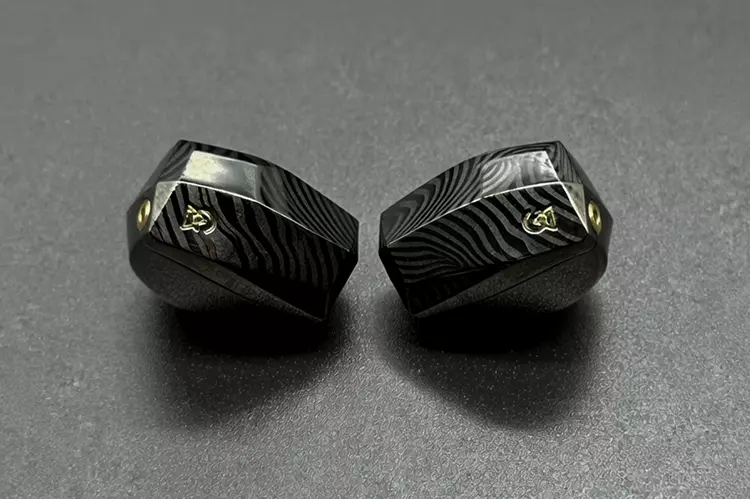
The housing is precision-machined stainless steel, and you can tell right away that it has got some weight and a robust, dense, hard, and shiny look.
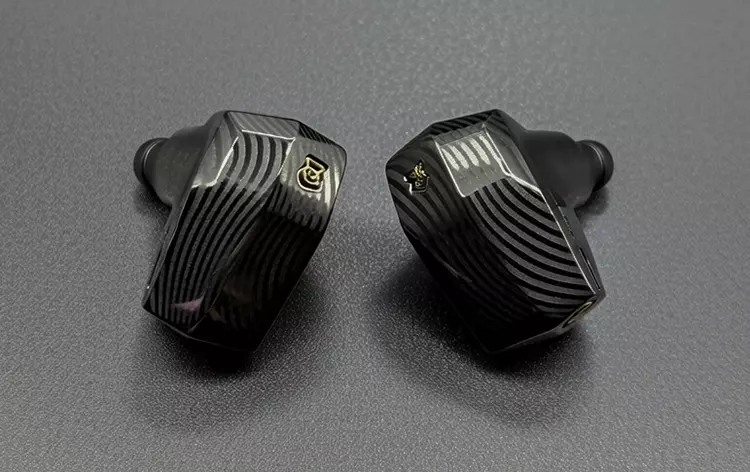
The shell shape is also a bit unusual. From the front, it feels longer and more stretched out than most IEMs. It looks more like a small, angular tool, with clean planes and sharp transitions.
The faceplate is the part that grabs attention. On the Launch Edition, it is real Damascus steel. It has flowing stripe patterns across the plate, almost like layered waves. It has a subtle yet premium look, not colorful, not shouty, just slick and mean.
The CA inlay is gold and pops nicely against the black shell. That glossy black finish can be a fingerprint magnet, and it is the sort of IEM you will want to baby a bit. I can imagine the other special gold version can look gaudier.
Campfire Audio also made a big practical change here. They finally ditched MMCX and moved to a 2-pin system. The sockets are recessed for stability, so the connection looks cleaner and feels more secure long-term.
On the shell itself, you can see a proper vent cut on the side. The nozzle is also nicely done, with a grille covering the opening, and it should help keep wax and dust out.
Overall, it is a proper looker, feels premium, and feels built to last. The regular Andromeda 10 is built with CNC aluminum and is lighter, with a more classic ‘green’ look. However, this black Launch Edition is the one that feels like a special piece.
Comfort & Isolation
The Andromeda 10 LE has that elongated shell design that can look a bit large in photos, but in hand, it feels average. More importantly, it sits right. The shells nestle in the ear nicely and do not feel awkward or bulky once you wear them. Comfort has not been an issue for me at all.
The nozzles are on the smaller side, and that helps more than you would think. Once you get a tip that grips well, the IEMs stay put without you having to push them in deep.
I feel that even people with smaller ears should be fine with the fit. They also do not stick out too much, so you are not walking around feeling that it is hanging off your ear.
Weight distribution is done well. You do not get that “pulling down” feeling, and they do not feel like they are hanging on the cable.
The lightweight stock cable helps here, so even in longer listening sessions, you do not feel pressure building on the top of the ear or around the concha. It just feels stable and easy to live with.
Isolation is decent. It is not the kind of deep isolation you get from some fully sealed resin shells, but it cuts enough outside noise to keep you focused on music.
I also did not run into any pressure build-up issues, and there is no driver flex either. Overall, it is a comfortable set that you can wear for hours without thinking about it.
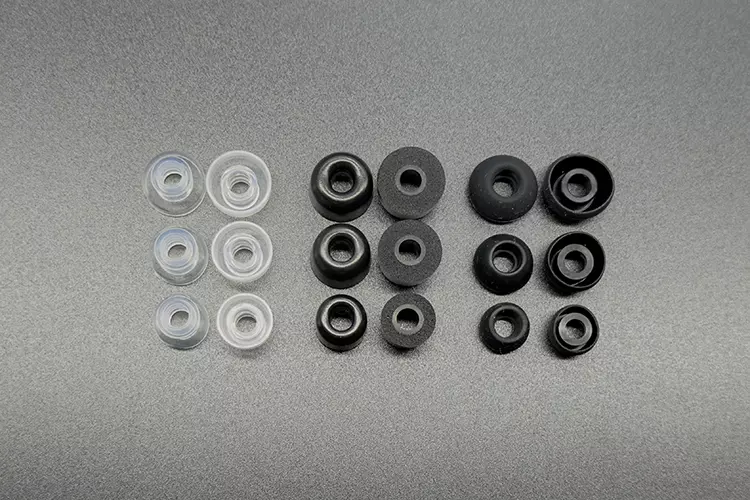
Ear Tips
The Andromeda 10 LE is stocked with three sets of ear tips: standard silicone, foam, and clear silicone.
Campfire Audio has included these same ear tips with recent releases such as the Alien Brain and Grand Luna. These ear tips come in three sizes: small, medium, and large. They are well-built, with a soft, premium finish.
The standard silicone ear tips have a very soft texture and pair quite well with the IEMs. I am not very fond of the ultra-clear silicone ear tips, as they tend to become sticky for me, but I do find them quite premium in build. The other black silicone ear tips are not sticky.
With the small nozzles on the Andromeda 10, these ear tips fit quite well, and I have spent enough time with the larger size.
Among the aftermarket ones I tried, the Divinus Velvet tips and the Eletech Baroque Stage ear tips fit quite well. I have been using the Stage ear tips a lot lately.
They expand the soundstage in both height and depth and keep the sound open enough. Personally, I find the Andromeda 10’s fit to be easy, so you won’t have to struggle much with finding the right-fitting ear tips.
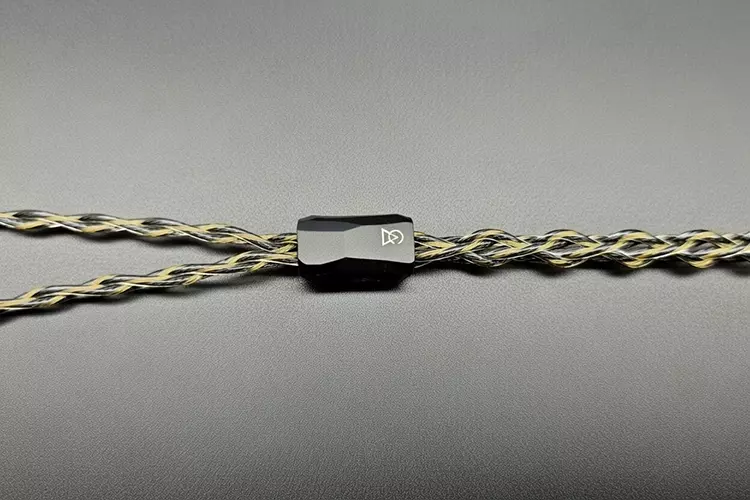
Stock Cable
The Andromeda 10 LE cable is clearly made to match the whole Launch Edition vibe, both in looks and in how it sits with the shells. The color scheme of black and gold weave lines-up perfectly with the black stainless steel shells and the little gold accents on the faceplate. The conductors are four large-gauge, gold-plated copper.
This LE cable is not modular, though. You get a straight 4.4mm termination, and that’s it.
If you want the swapping convenience, that is what the regular Andromeda 10 gets with the Time Link modular cable, allowing you to swap between 3.5mm, 4.4mm, and even a USB-C DAC termination. It is more of a “do everything” cable, whereas the Launch Edition is more focused.
In hand, this cable has a nice middle-ground feel. It is not too soft and floppy, but it is also not stiff or annoying. It bends easily and sits comfortably around the ear. Storing is also an easy affair, as it does not fight you when you coil it back into the case.
Hardware is kept simple, which I like. The Y-split and the chin slider have smooth edges and a clean finish. The plug looks especially nice, with a more angular barrel shape that gives it a bit of character. Up top, the 2-pin connectors look tidy and sit snug.
Overall, it is one of those stock cables that does not make you rush to upgrade. It works, it feels good, and it fits the IEM’s styling properly.
Of course, with 2-pin, cable swapping is always tempting because we are all like that, but you do not really need to swap this one unless you want a different look or a different termination.
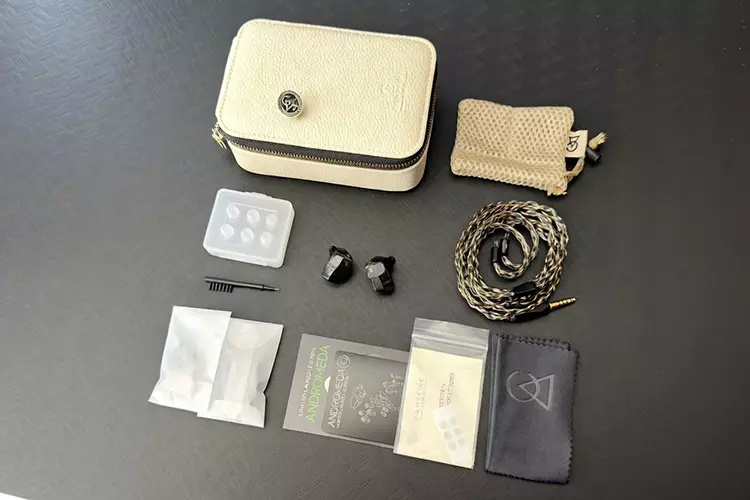
Packaging & Accessories
The Andromeda 10 LE packaging feels vibrant without trying too hard. It arrives in an average-sized cardboard box.
The whole thing is drenched in that familiar Andromeda green theme, with the artwork sitting front and center and the branding laid out cleanly. It has that “Campfire” identity immediately, and if you have seen their recent releases, you will recognize the style.
The box opens from the front like a book, and that first flip is satisfying. The inside of the upper flap has a nice bit of Andromeda 10 artwork, so it does not feel like dead space.
The whole thing sets the tone, and it makes the unboxing feel a bit more special than just pulling foam out of a lid.
Once you open it up, the layout is straightforward. On the left, the big beige carry case is sitting there. It instantly becomes the star of the unboxing because it looks and feels like something you will use.
On the right, the IEMs are tucked into foam cutouts, safe and snug, and you also spot a small Campfire Audio pin sitting alongside them.
All the accessories are inside that large case, which is honestly the right call. You open it, and everything you would expect from a premium set is there.
The cable, three sets of ear tips, a cleaning tool, and a cleaning cloth. You also get a mesh pouch, and this one is not a throwaway extra. With these shells, you want that extra layer of protection.
The case is roomy enough that you are not playing Tetris every time you pack it up. You can fit the IEMs, cable, and tips and still have breathing room, which makes the whole package feel more thought-out than flashy.
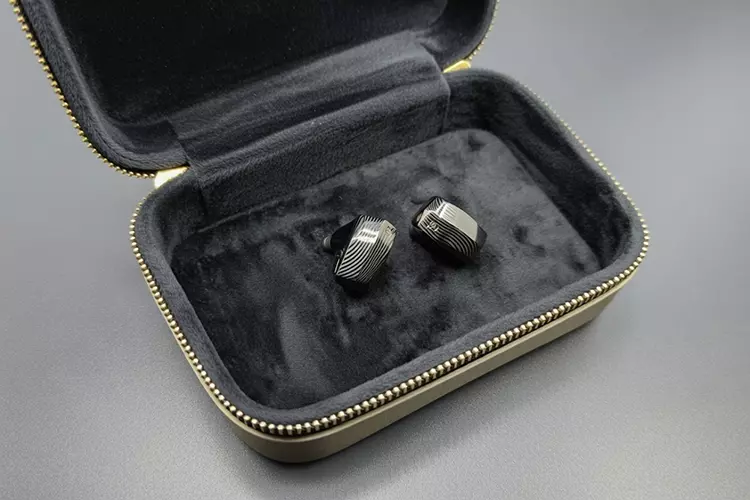
Carry Case
The carry case here is the kind that makes you grin because you know you can use it daily without playing the “how do I fit the cable and shells without stressing them” game.
The outside has a soft feel with a pebbled texture, so it feels premium in hand and not like a generic hard puck case.
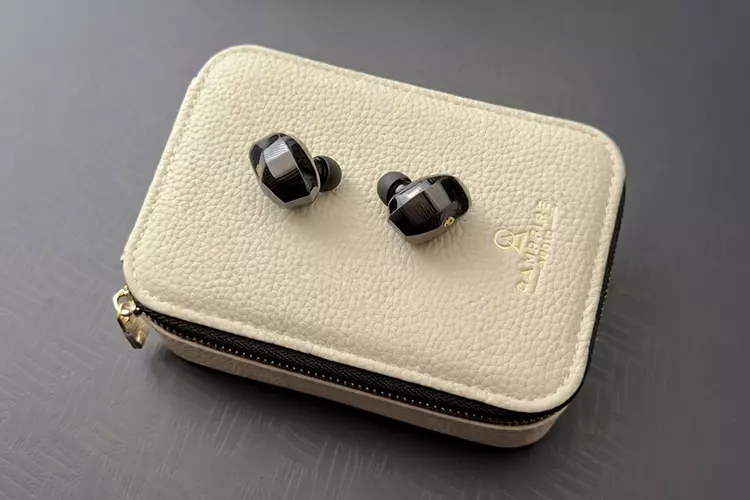
The standard one comes in classic Andromeda green. Mine, with the Launch Edition, is a light beige color. It looks clean and classy, but yeah, it can get dirty if you toss it around. A quick wipe occasionally, and it is fine.
On the front, you get the Campfire Audio branding stamped. The zip hardware is gold and feels solid, which adds a nice premium touch.
Inside, it is plush. Velvet lining all around, soft enough that you do not worry about the shells rubbing against something rough. On the top lid, there is a stitched Campfire Audio logo and a small pocket that is useful.
It is perfect for extra tips, adapters, cleaning tools, and that kind of stuff. The best part is the space. The IEMs and the cable fit easily, no struggle. It is roomy enough that you can even throw in another small set if you really want to.
And I like that Campfire Audio gives you those little mesh pockets for the shells. I use them every time. With the Andromeda 10 LE being a scratch magnet, it just feels safer to tuck the shells in there before closing the case.
Even with the regular Andromeda, it is a good habit because paint chips and knocks are real when two shells slam into each other in a bag. This case makes that whole routine easy, and that is why it works.
Click on page 2 below for my sound impressions and recommended pairings.
Click on page 3 below for my selected comparisons.
Related Posts

What’s New in the 64 Audio TWELVE Ti Special Edition?

AFUL Performer 8S Review — Headfonics

Meze Astru Review – Headfonia

Aful Performer 8S Review – Headfonia

Best Gear & Recommended Buys

FiiO EH11 Review — Headfonics

Strauss & Wagner Review: Silphase Silicone Eartips

Cayin T201 Review — Headfonics

HiBy Digital M500 x Hatsune Miku 4G Review — Headfonics

Luxsin X8 Review — Headfonics

FiiO EH11 Review – Headfonia
