
Blog
HIFIMAN Arya WiFi Review — Headfonics

Louis reviews the HIFIMAN Arya WiFi, a new set of WiFi-enabled open-back planar magnetic headphones with lossless audio receiving capability. It is currently priced at $1199.00.
Disclaimer: I received this sample in exchange for my honest opinion. Headfonics is an independent website with no affiliate links or status. I want to thank the team at HIFIMAN for their support.
Click here to read more about the HIFIMAN products previously reviewed on Headfonics.
This article follows our current scoring guidelines, which you can read in more detail here.

HIFIMAN Arya WiFi Review
Summary
The open-back planar HIFIMAN Arya WiFi could be one of the best-sounding wireless headphones to date because nothing on Bluetooth can match the sound quality of lossless WiFi. Even on Bluetooth, it has a competitive edge over most others.
Wireless Performance & Features
8.6
Pros
Excellent sounding wireless lossless audio with no boundaries.
Connectivity versatility.
Very comfortable headphone to wear.
Cons
The volume control needs refinement.
No standard cable connectivity.
No PC WiFi functionality, yet.
I see HIFIMAN as one of the most radical headphone companies out there because they’re constantly pushing boundaries.
Just look at their latest open-back, driver-exposed, unveiled concept, for example, and you’ll agree. This concept has been incorporated into the Susvara Unveiled, HE1000 Unveiled, Arya Unveiled, and Ananda Unveiled, and the design is far from conventional.
You can also see the same forward-thinking concept with their Topology technology, which is also far from ordinary. These are concepts no one else has attempted, but HIFIMAN has successfully implemented them within a competitive market.
So let’s take a look at their latest uptrend. HIFIMAN is currently developing a line of WiFi headphones, which has been done before, but not in an upscale manner like this.
HIFIMAN promises top-notch sound over the air with this newly released line, which I call their wireless multi-connectivity line. Let’s start with the $1199 Arya WiFi and see how it stacks up against the ‘regular’ Arya Unveiled.
Features
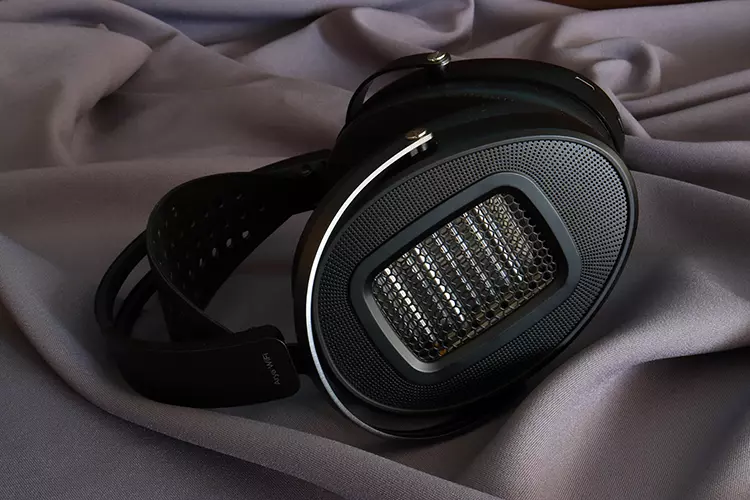
I chose that affectionately assigned title because I don’t recall a single headphone that offers all the connectivity that HIFIMAN threw into the new Arya WiFi. The main selling point here is the WiFi connectivity via the built-in receiver.
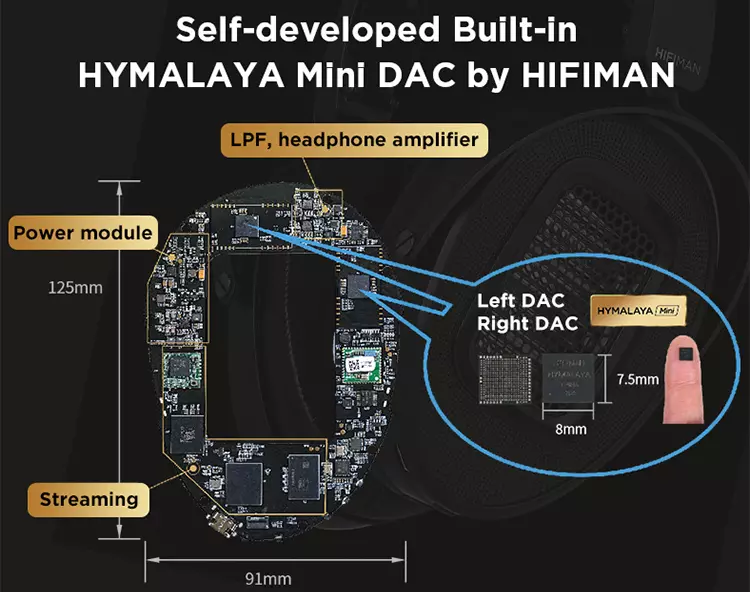
But the Arya WiFi also has a built-in Bluetooth receiver, a mini Hymalaya R2R DAC with an integrated headphone amplifier with additional USB-C connectivity. This gives the user three connectivity options: WiFi, Bluetooth, or USB.
The Arya WiFi is a self-contained high-fidelity headphone system that doesn’t need an external amplifier or anything else.
You use a digital audio transmission via Bluetooth, WiFi, or via USB cable, similar to feeding a DAC, which will feed the amplifier section exclusively, with no need for a dongle or anything else.
There are no conventional ports with 3.5mm connectivity, and that’s the bad part. But at least you can use the included USB cable, which gives you the sense of using them wired.
Driver
The driver retains an asymmetrical shape but gains some of the Audivina tuning implementations.
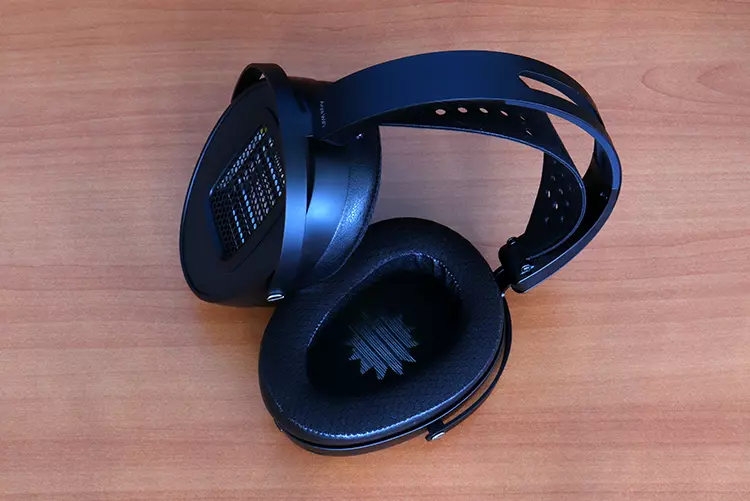
If you look at the inner portion of the cup, for example, you’ll see the same thick cloth with a multi-pointed star cutout in front of the driver. This has not been implemented on any of the previous Arya Headphones.
This tuning implementation worked well on the recent Audivina LE, which turned out to be a good-sounding closed-back from HIFIMAN.
But these headphones have totally different drivers. These drivers are certainly in line design-wise with the drivers used on the previous Arya line.
The magnet structure uses HIFIMAN’s Enhanced Magnet design, which is a tweaked Stealth Magnet design along with the nanometer-thickness diaphragm, which they call their NEO supernano diaphragm.
The driver size also stayed the same as the rest of the Arya lineup. The magnet structure is also dual-sided. All these visual cues lead me to believe the drivers are similar to those used in the Arya Unveiled, but tweaked.
Mini Hymalaya DAC
When the original DEVA was released, I was immediately impressed by the removable DAC amplifier module that attached to the bottom of one of the cups.
I thought that was a revolutionary and very useful feature because, as long as HIFIMAN retained the same bottom cup dimensions, you could then use the same module on other cans.
On this occasion, HIFIMAN went for a built-in circuitry that handles all digital-to-analog conversions and amplification, along with handling all the connectivity.
This has, more than likely, an upgraded set of electronics compared to the DEVA module, but not many specifics are given on that front.
The amplifier section of the Deva module was capable of 1W per side, and the internal section of the Arya WiFi seems to have a similar amount of output power.
I do feel like the electronics would have been best if placed on a separate module, similar to what the Deva came with, to be honest.
That way, you could have bypassed the module, and that would allow you to use desktop power units like HIFIMAN’s own Serenade, the EF400, or the EF600.
This would have been beneficial by enhancing the versatility of these amps with additional wireless features.

WiFi
The main feature of the Arya WiFi is encrusted in its name, but it’s not the first time this has been done. It’s been done by HED on their Unity headphone. Dali has their 10-12. It was also done by Koss back in the day. Xiaomi also made some earbuds that were WiFi-capable.
HIFIMAN doesn’t disclose what chip they use, but some research will lead you to either a Qualcomm XPAN or S7 platform as the latest iteration of Qualcomm’s WiFi-capable chips. Perhaps that’s what HIFIMAN is using here.
I do worry about WiFi and long-term exposure, but apparently HIFIMAN is using a micro-power module that gives you just enough range within an average home, and keeps the output levels very low and at safe levels.
The way they connect to WiFi is very simple. There’s a video on YouTube for the network configuration guide that nails the procedure.
You put them into AP network configuration mode, connect them to your mobile devices’ WiFi using 88888888 as the password.
Then, you open a browser and connect to 192.168.2.1, which will give access to the built-in streamer, and from there, you enter the password of your router. At that point, the Arya WiFi should start showing up as a cast device on whatever app you decide to use.

Bluetooth
The HIFIMAN Arya WiFi’s Bluetooth radio runs on the latest 6.0, and it runs most of today’s modern-day codecs. It plays well with LDAC, AAC, SBC, and most aptX codecs. I’m assuming it uses the latest Qualcomm chip; more than likely, it’s a 5181.
But I was surprised to find that there was no aptX Lossless capability. I did get an early build, and in the future, HIFIMAN could perhaps offer an upgrade via a firmware update to handle that codec, which is the best sonically and a slight improvement over LDAC.
I connected the HIFIMAN Arya WiFi via Bluetooth with FiiO’s AIR LINK and the Questyle QCC Dongle Pro, to see if I could run the aptX Lossless codec just in case, but it doesn’t work.
It tops off on LDAC. The Lossless codec is not available at this time on this headphone, and to be honest, at this tier, that’s egregious.
I didn’t find a way to kick the HIFIMAN Arya WiFi into a low-latency mode, but to be honest, latency was never an issue while testing the Arya WiFi on Bluetooth.
I couldn’t test latency on WiFi, but since this method of connection will more than likely be used for music listening, latency will not matter much.
To access the Bluetooth pairing, I found that by pressing the power button three times quickly while on, it would force the set into Bluetooth pairing mode, and the LED would start flashing alternating colors, and at that point, it would show up under the ” Pair New Devices ” list.
I did obtain a solid connection, and using a BT6.0 transmission enables one to walk around certain corners in an average home with little to no blackouts. This is one of the first times I have tested a Bluetooth device that is capable of running beyond a visible line.

Design
The overall Arya WiFi design follows the new HIFIMAN headphone lineup.
It uses the company’s latest headband assembly, which they call their second-generation headband assembly, in combination with HIFIMAN’s Asymetrical cup design. This one is more like the fifth iteration of their headband design.
The HIFIMAN Arya WiFi’s color scheme is generally black with some small silver accents here and there, and more prominent on the magnetic structure that’s visible through the black hex-shaped perforated metal grill that protects the driver.
Supposedly, this is the most serviceable headband HIFIMAN has ever released, and I can see one screw holding the headband on each side that acts as a pivot. I can also see a set of screws on two sections where the sliders are.
The cups seem to be made from a combination of plastics and metal. The yokes are metal, and parts of the headband assembly are also a combined construction of plastics and metal.
My only concern about the overall design is that there’s no standard wired connectivity, meaning they cannot connect to a conventional headphone amplifier.
Comfort
I thought the Arya WiFi would be considerably heavier than its original wired counterpart since it is loaded with more electronics and a battery. But weight is kept down to a very reasonable 452 grams.
This was apparently accomplished by using less metal on this new generation headband, which forms an arch and eliminates those unsightly metal spring corner protrusions on top that were not visually pleasing at all.
There’s a small portion of the audiophile population that might find the clamping force to be a bit snug.
The problem is the limited expansiveness of the headband, which doesn’t allow you to expand it much. It’s restricted by the length of the headstrap. On this set, the largest of heads will feel some clamping force.
Design-wise, that limited expansiveness saves the headband from excessive expansiveness itself, which can cause stress cracks.
I’m guessing that HIFIMAN did extensive research and gave us just enough room for the 99% of us. Only those with the largest of heads, 23 and above in hat size, would find these unideal; the rest of us are good.
Me? I found the Arya WiFi comfort level to be in the high category, with just a hint of warmth and a slight stuffy feeling due to the large cup size that covers most of your head’s side.
I do have a feeling that once the pads start softening up, comfort levels will increase a minuscule amount.
Stock Pads
The Arya WiFi pads are similar to what HIFIMAN is using on most of their new headphones. They use the 9-point clip-on system rather than the velcro attached pads used on the Audivina and the new LE variant, which I liked a lot. Wink, Wink, HIFIMAN.
The pads are a hybrid type with perforated innards, a vegan vinyl on the outside, and a cloth on the part that touches your cheeks. The cushion inside is not too stiff, but it doesn’t feel like memory foam because it bounces back too quickly and doesn’t conform much either.
The fact that they follow the HIFIMAN traditional asymmetrical design with a large oval cavity makes them comfortable to me automatically. I can almost put two ears in there, and the foam is not too stiff with a little bit of give.
But again, their longevity concerns me, and my experience with HIFIMAN pads has a get-you-by construction that leaves you looking for new pads in less than 6 months.
Their stock cables are similar in that they leave much to be desired, and the same can be said about the included USB cable.
Controls
The Arya WiFi has four onboard buttons plus a hidden button behind an orefice that’s used to reset the WiFi settings and restore the WiFi streamer to a default state.
There’s also an orifice that looks as if the Arya WiFi comes equipped with a microphone, but I couldn’t verify if it was one. So don’t go poking around in that hole.
There are two volume buttons, which, in my honest opinion, need refinement because they do not employ fine adjustment.
Each volume step is set too wide apart, and it makes it a bit difficult to obtain a perfect volume level. There are points where one step up, and the volume almost doubles. That needs work.
The other buttons are the power button, which you hold to power up and hold to power off. The power button also doubles as a Bluetooth pairing mode button and sports a mode LED.
Then there’s the source selector, which, with each press, scrolls through the three connecting modes.
The source selector, when powered for the first time, defaults to Bluetooth mode. One press of the mode button will put the Arya WiFi into WiFi mode, and another press puts it into USB mode.
The button has a single LED that remains off in Bluetooth mode, lights up green in WiFi mode, and a reddish pink in USB mode.
Battery life
The Arya WiFi has a built-in battery that can be charged via a USB-C port, but for the battery to receive a charge, you have to turn off the electronic module
One thing I noticed about the built-in battery was that it took over three hours to charge from a self-shut-down state to fully charged. That was with a 10-watt, 5V, 2.1-amp charger. I used a more potent 25-watt adapter, and there was no change.
As far as battery life, on WiFi, I obtained around 5.5 hours of playback cranked up at around 75% volume. On Bluetooth, I obtained around 11 hours of playback, which is still an ample amount of time, but never did I obtain anywhere close to HIFIMAN’s specified 23 hours.
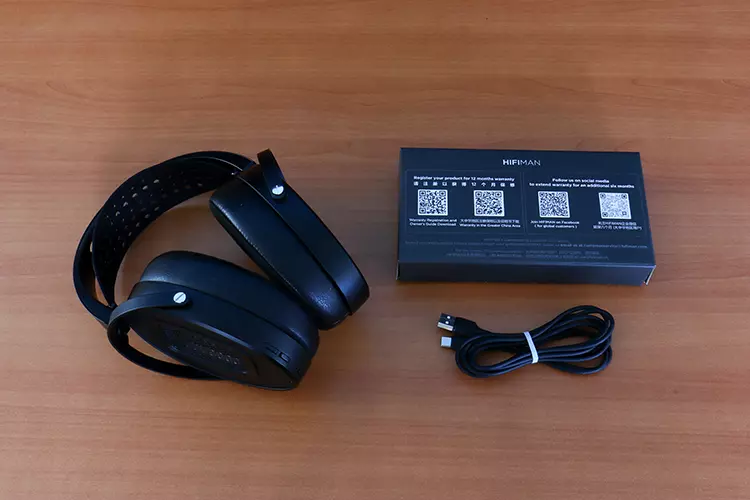
Packaging & Accessories
I received the Arya WiFi in HIFIMAN’s new style brown box with a laminate across the top that also acts as a seal, and assurance of receiving a sealed unit. The laminate distinguishes the contents of the box.
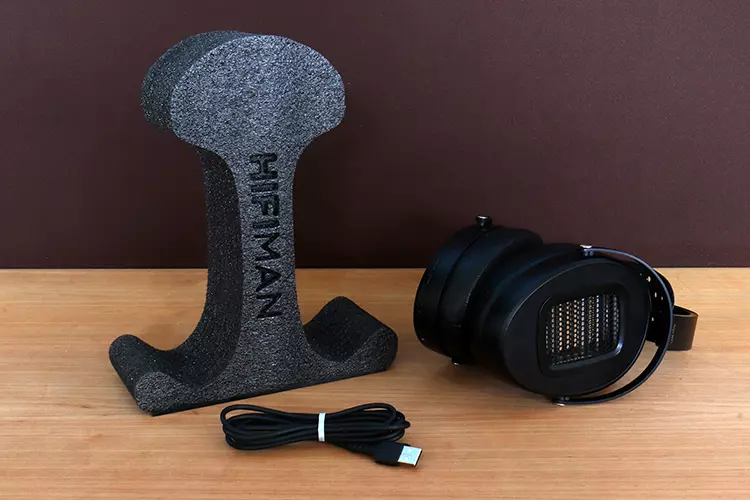
The only accessory that was shipped with the HIFIMAN Arya WiFi is a basic 6-foot USB cable inside a smaller box. There was no included owner’s manual or anything else.
This is a complex headphone that is simple to use, but its use might present a challenge to some users with no networking know-how. Minimum, HIFIMAN needs to include a QR code that takes you to the connecting instruction video previously mentioned.
You do get a foam headphone stand that’s part of the packaging inside the box, and it keeps the headphones from jumping around inside the box during delivery time.
I would have liked to see some sort of storage bag included as well, at a minimum. Remember, we’re looking at a high-end model here, but the presentation and the included accessories are somewhat lackluster for this product’s caliber. That’s just my opinion.
Click on page 2 below for my sound impressions and selected comparisons.
Related Posts

Audeze Maxwell 2 Review: Your Next Gaming Headset Upgrade

FiiO SNOWSKY DISC Review — Headfonics

Campfire Audio Iris Review — Headfonics

Hidizs MP145 PRO Review — Headfonics

ThieAudio Cypher Review

Questyle QCC Dongle Pro Review

EarMen L-AMP MK2 Review

FiiO M33 R2R Review — Headfonics

THIEAUDIO Cypher Review — Headfonics

Vision Ears VE ONE Review — Headfonics

OMNE Audio Hendeka Review
