
Blog
Luxsin X8 Review — Headfonics

James reviews the Luxsin X8, a new AI-driven desktop eight x CS43198 DAC and 4.8W-capable balanced headphone amplifier priced at $699.
Disclaimer: I received this sample in exchange for my honest opinion. Headfonics is an independent website with no affiliate links or services. I would like to thank Luxsin Audio for their support.
You can click here to learn more about the Luxsin audio products previously reviewed on Headfonics.
This post follows our current scoring guidelines, which you can read in more detail here.
Luxsin X8 Review
Summary
The compact desktop Luxsin X8 DAC and headphone amplifier is an ideal choice for anyone craving an expansive stock tuning, and curious about the customizable listening experience, but hesitant to dig deeper into the complex controls of PMEQ.
Pros
Interactive AI Tuning.
Vivid neutral-warmish tonal profile.
Friendly app UI/UX.
Cons
AI engine limited to adjusting FR.
Switching between user-created tonal profiles might be clumsy.
Auto impedance select might not yield the best result.
I never imagined reviewing desktop audio gear with AI features. Not this soon, at least. Yet after the Luxsin X9, its cheaper sibling, the X8, now sits on my test bench.
Out of nowhere, the X8 introduces an AI-EQ bot that lets users shape the sound simply by typing text prompts, no technical expertise required. It also delivers higher output power and employs an array of eight CS43198 DACs for high decoding performance.
Priced at $699 and cheaper than the X9, Luxsin positions the X8 as a more approachable, engaging option for listeners craving musicality and generous drive over clinical accuracy, plus even greater control over the tonality.
With features that seem too good to be true, this review will examine how the AI function performs in practice, evaluate overall sound quality, test pairings with various gear, and compare it head-to-head with the X9 and key competitors in its class, such as the D&A Alpha PRO.
Features
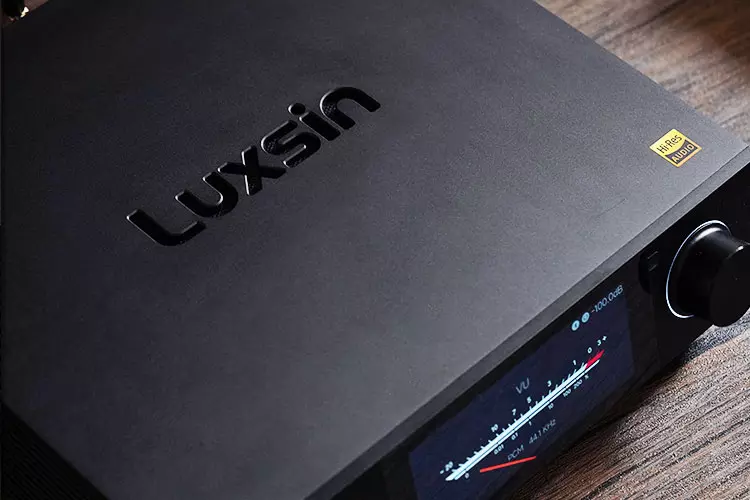
The Luxsin X8 uses eight Cirrus Logic CS43198 DAC chips, four per channel, in its fully balanced pathway, with decoding up to DSD512 native and 32-bit/768kHz PCM.
Sheer output power is higher on the X8 than the X9, measuring 4840 mW per channel into 16 Ω on the BAL output, with THD+N under 1%. SNR is also decent at >123 dB.
The default output impedance is low at just 1Ω, so it pairs easily with sensitive designs like the Meze Audio 105 SILVA without sacrificing much in the way of dynamics.
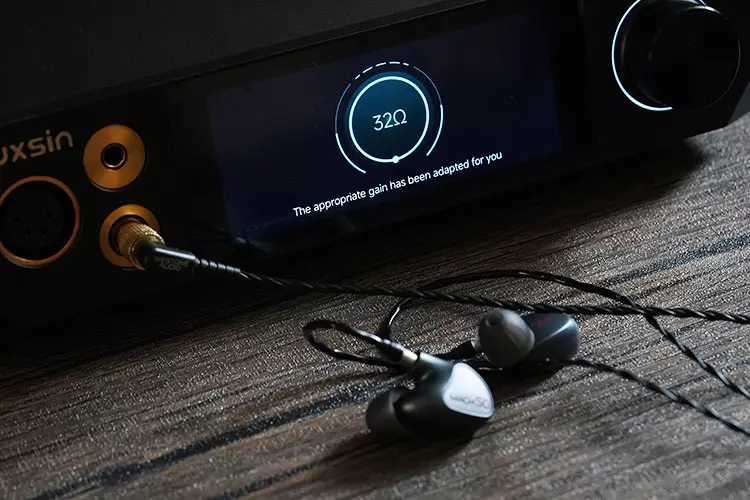
The Luxsin X8 also features automatic impedance detection across all front-panel outputs. It automatically selects the optimal gain setting to maximize amplification efficiency, headroom, and dynamics when plugging in gear.
Design
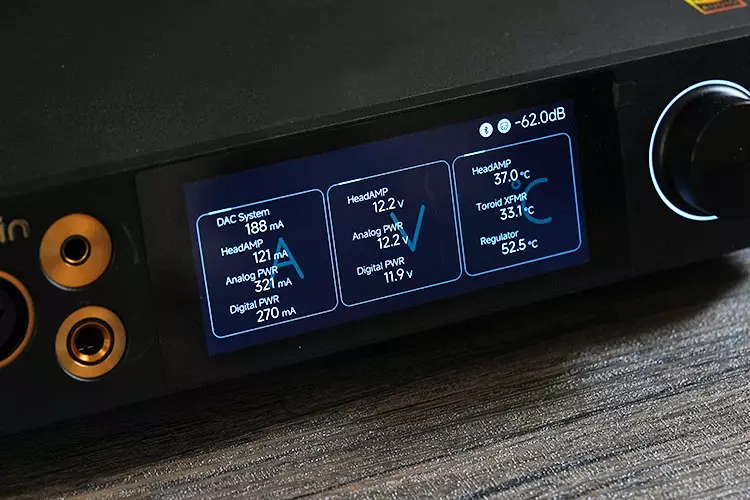
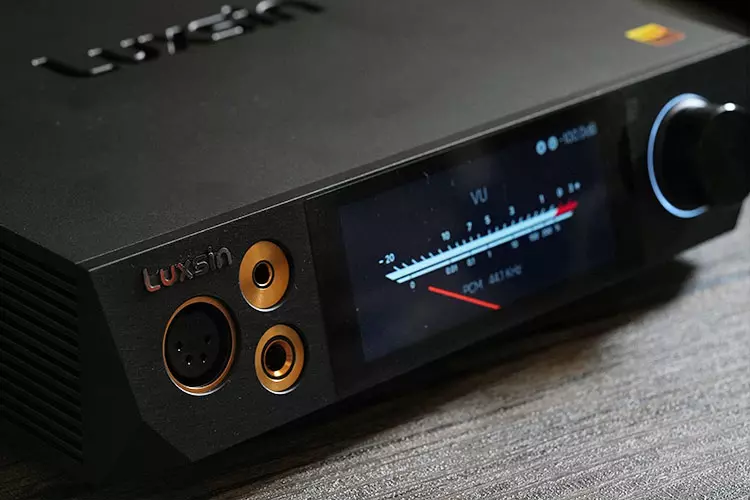
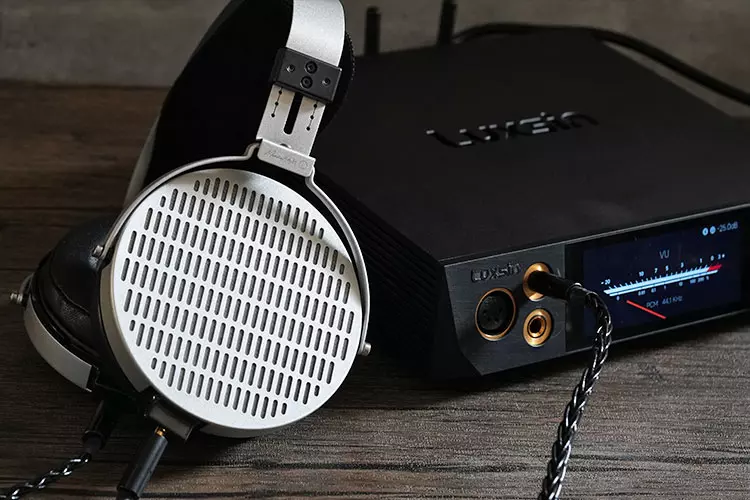
The X8 closely resembles the X9 in its design language, sharing a tilted 4″ touchscreen and heat‑dissipating side grills. While it lacks a dedicated front power button, a rear switch lets you fully disconnect it from mains power.
Construction is robust and professionally engineered. The bold, faceted front panel conveys rigidity, and the tilted display makes on‑desk or rack use effortless. You can also control the unit from a PC or via the mobile app and remote it over the living room.
Viewing from the top, you will also see the logo smartly carved out for heat dissipation. The metal housing is thick, and the casing design feels very solid, which helps suppress resonance.
I/O
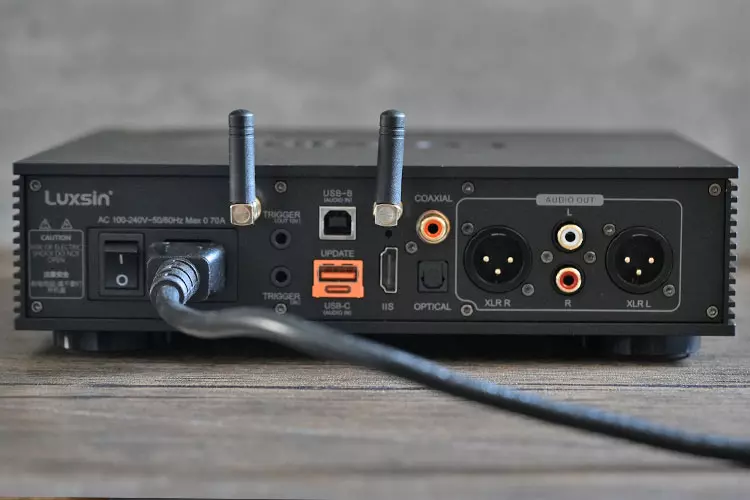
Flipping to the rear panel, it includes USB‑B and USB‑C ports for USB decoding up to PCM 32‑bit/768 kHz and native DSD512. An HDMI port supports I²S at the same rates.
Coaxial and optical inputs handle up to PCM 24‑bit/192 kHz, and Bluetooth 5.1 provides wireless playback with LDAC and AptX HD. You can toggle between all these in/output options from the main menu within 3 clicks.
I appreciate Luxsin’s backwards compatibility in retaining USB‑B. You can use legacy upgrade cables without relying on adapters, while the USB‑C port future‑proofs the unit for modern laptops, phones (OTG) with supporting apps, and streamers.
Connectivity
Wireless
The Luxsin X8 uses the Qualcomm SXW5125 Bluetooth chipset, supporting LDAC, aptX HD, aptX, aptX LL, AAC, and SBC for varied use cases.
Pairing with Windows, Android, and iOS is quick, making streaming around the home effortless. With aptX LL, the amplifier may also work with low‑latency gaming.
While Bluetooth is handy, I would prefer a USB connection or other digital-in over Bluetooth, as you can clearly hear the output being much more refined and more detailed on the X8.
Wired
The X8 supports UAC2, which means it can be plug-and-play on Windows and macOS without the need for a driver. You can also download an ASIO driver from Luxsin’s site for more stable high‑res playback.
If your mobile device supports USB output, you can connect it to the X8 via the USB‑C port and enjoy USB decoding, which provides superior quality to wireless. For instance, I used UAPP, and without any trouble, it connects and plays right away.
Controls
In addition to the physical knob and touchscreen, the X8 can be controlled via a web portal and mobile apps for iOS and Android.
Through the apps or web interface, you can use AI‑EQ prompting and HP‑EQ, adjust system settings, choose built‑in headphone profiles and DSPs, control volume, and manage firmware. The UI/UX is well-designed and responsive.
AI-assisted PMEQ
The PMEQ is powered by an ARM processor and dual-core HiFi-5 DSP chips, delivering a user-friendly, responsive, and intuitive experience. Use it by installing the Luxsin app or configuring via the web portal on a PC.
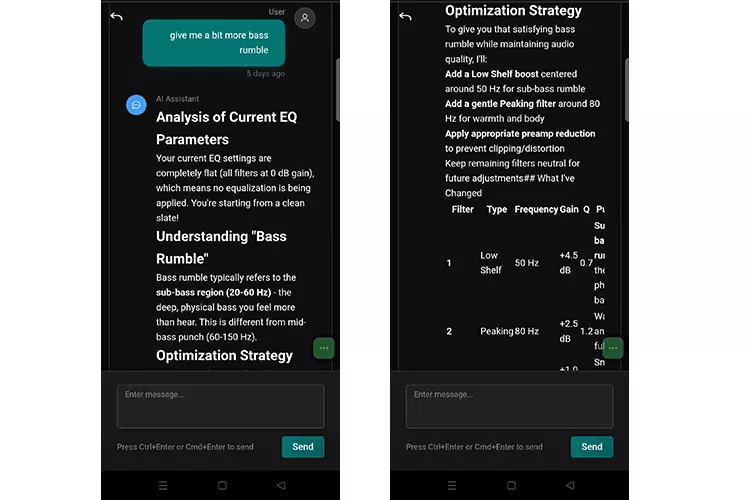
Its AI input interface lets you enter prompts to guide tuning, for example: “Make the treble less bright without affecting openness,” “Follow the HD 800S tuning direction,” “Give vocals more power,” or “The low end feels overly congested.”
The AI proposes a tweak, displays a comparison with the original curve, and lets you accept it, refine it with another prompt, or manually adjust.
You can scale adjustments for subtler or stronger effects. Once confirmed, the curve saves as a profile and applies instantly. You can also switch between current and previous curves in 2 clicks.
Another way to use the AI is to identify flaws and create corrective curves, e.g., prompting “What issues does the HD 800S have, and help me design a fix?”, then refining the magnitude and shape until satisfied.
Layman’s terms work fine, and it provides feedback to correct issues without needing technical expertise.
Like any chatbot, results depend on prompt quality and clarity of intent. Still, it’s excellent for learning tuning, EQ design, and equalization.
It explains each suggested change and its likely sonic impact, building your understanding of how adjustments and frequency intensities shape sound.
While there is some limitation, it alters timbre only by reshaping the frequency curve; for X8’s positioning, this is perfectly fine.
Despite this, it would be lovely for Luxsin to consider adding more DSP effects, like tweaking overtones, adding overdrive, or enhancing spatial separation, to make the device even more powerful.
HP-EQ Custom Profiles
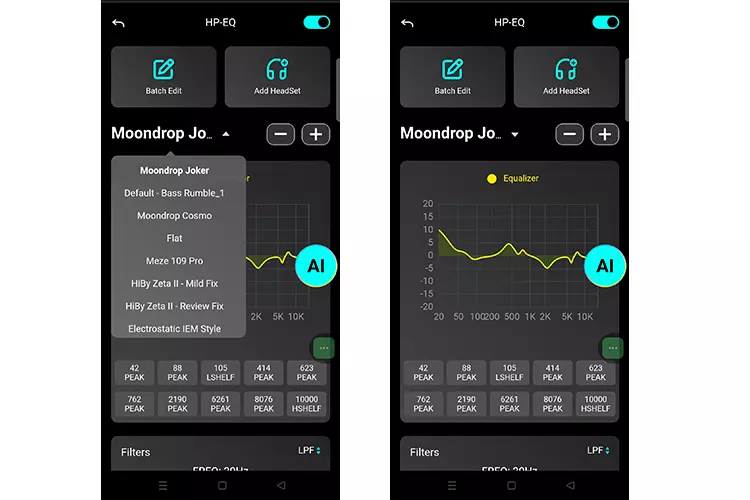
The Luxsin X8, like the X9, ships with 2,500+ growing headphone profiles and selectable target curves with hardware EQ.
You can search by model and save a shortlist of frequently used headphones for instant profile switching.
Beyond the basics, the UI lets you choose multiple target curves and configure crossfeed, filters, and other DSP settings, on-screen or from other devices, and toggle or combine them to compare effects.
This intuitive, powerful configuration panel is among the best on headphone amplifiers, offering real flexibility with easy operation.
Packaging & Accessories
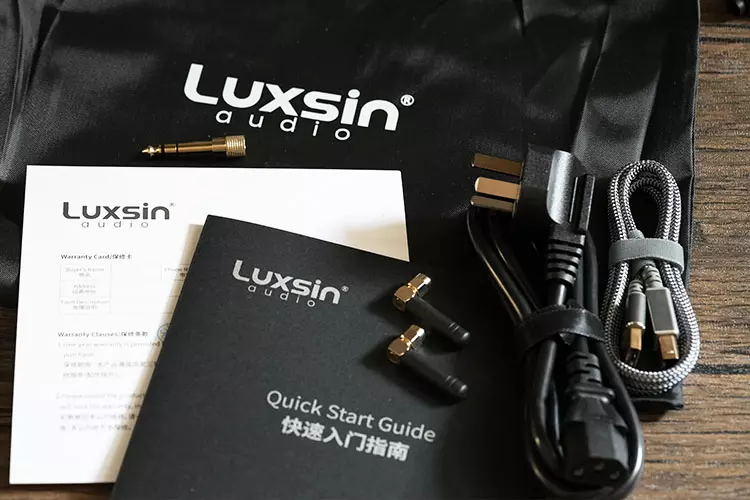
The Luxsin X8 ships in a sturdy cardboard outer box with an inner foam‑padded box. Inside the unit is protected by a storage bag, and the package includes a power cord, a USB‑B cable, and a 6.35 mm-to-3.5 mm adapter.
Sound Impressions
I ran in the X8 for about a week and paired it with a range of headphones to test versatility, including the MOONDROP COSMO, Meze Audio’s 105 SILVA, the Sennheiser HD 800S, the HIFIMAN Isvarna, and the Ananda Nano.
The impressions below are based on various pairings and mainly on USB decoding connected to my PC.
Summary
The experience with the X8 is genuinely fun and feels like a tuning approach that would have been unimaginable a year ago. To be honest, I don’t expect this to happen this fast and be practical.
The AI tuning process is speedy, and in most cases, it doesn’t mess up the entire curve to sound bloated or veiled at all.
For those who do not want to spend time fiddling with EQs, fix known issues in the tuning, and focus on listening, this acts as a truly usable AI EQ assistant. It is also more flexible than many on pairing since it takes very little time to improve a match.
Despite the increased power, the X8 remains easy to pair with sensitive headphones and delivers dynamic, well-controlled bass without losing layering.
Its higher output also suits high impedance headphones, while the slightly more mid-centric tuning balances nicely with the energy in the treble.
Timbre
The stock tuning on the X8 is clean with a touch of warmth and adequate extension at both ends.
I hear a mild M shape with punchy bass that is not overly deep, slightly elevated vocals for intimacy and warmth, and clear treble that never goes over the threshold to sound too hot. The soundstage is extended and pretty well-layered.
Vocals can seem slightly laid back or flat with some higher impedance loads or very sensitive designs, but the tonality improves noticeably after equalizing.
After applying built‑in target curves or AI EQ, transients tighten, and the bass attack slims down to sound more precise and deeper.
In one example, I asked the AI assistant to “tame the final A8000”. Before EQ, it is a bright IEM that can approach the sibilance threshold while offering a lot of air and highly articulated treble with a crisp, fast response.
By asking the AI to reduce the sibilance zone and soften cymbal sharpness, the peak gets rounded, and the A8000 gains a sweeter, less aggressive treble character.
Another test involved using AI EQ on the HD 800S to impart traits of the HD 800, which is more open and extended, but sometimes less forgiving.
My process was simple: ask the AI to highlight key tuning differences, then request it to apply HD 800 traits to the HD 800S. The result was a more open presentation with a swifter, clearer treble.
Overall, I find the output expensive and quite vivid in tuning. Dynamics could be stronger, and the bass can kick a bit more solidly and deeply.
But that is exactly what the HP-EQ or AI-EQ features do to help, and to make it even better by fixing known tuning issues and shifting the sound signature toward a more engaging, balanced presentation in most cases.
Staging & Dynamics
The base tuning does not overemphasize either end of the spectrum. The X8 nonetheless sounds well extended in the treble and slightly full in the bass before any equalization.
This is fine because selecting target curves or applying AI EQ quickly improves dynamics, tightens bass impact, adds bass layering, and smooths the treble.
The eight DACs give the X8 enough power to preserve adequate layering even with orchestras, more on the horizontal plane than in lateral depth when loads get demanding.
Yet the DSP maintains a distinctive image for each element even when multiple frequency bands are adjusted by more than 6 dB.
Users can also manually switch tonal profiles or use AI EQ to lift the treble for more air, or boost the bass for greater rumble.
Within a 3 to 6 dB boost, there remains sufficient clarity and control for the image to stay cohesive, providing useful headroom to shape the signature unless the paired gear is very veiled.
Click on page 2 below for my recommended pairings and selected comparisons.
Related Posts

FiiO EH11 Review – Headfonia

Meze ASTRU Review: A New Star for High-End In-Ear Monitors

FiiO SNOWSKY ECHO Review — Headfonics

Audeze LCD-5s Review — Headfonics

Sony WF-1000XM6 Review: Has Sony Reclaimed the TWS Crown?

Noble FoKus Prestige Encore Review

HIFIMAN Arya WiFi Review — Headfonics

Audeze Maxwell 2 Review: Your Next Gaming Headset Upgrade

FiiO SNOWSKY DISC Review — Headfonics

Campfire Audio Iris Review — Headfonics

Hidizs MP145 PRO Review — Headfonics
