
Blog
Verum Audio Verum 2 Review — Headfonics

Louis reviews the Verum Audio Verum 2, a 2nd-gen set of boutique-designed open-back planar magnetic driver headphones priced at $499.00.
Disclaimer: I received this sample in exchange for my honest opinion. Headfonics is an independent website with no affiliate links or services. I want to thank Verum Audio for their support.
You can click here to learn more about the Verum Audio products previously reviewed on Headfonics.
This post follows our current scoring guidelines, which you can read in more detail here.
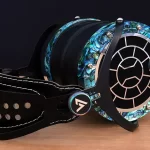
Verum Audio Verum 2 Review
Summary
The $499 Verum Audio Verum 2 open-back planar headphones offer top-notch leather pads, hand-rolled drivers, a general assembly that’s at the artisan level, and a punchy, energetic, and soothing sound signature that I can listen to all day long.
Pros
Uncommonly good bass for a planar.
Robust construction.
Two pads and two cables included.
Cons
Some might find the midrange too forward.
Simple packaging with no retail box.
The design aesthetics can be polarizing.
I admire ventures like Verum Audio. They’ve done what I wanted to do 30 years ago: make my own audio gear due to the expense on the consumer end, and back when I was growing as an audiophile and going through some hard times.
I quote Verum Audio when I say “not so long ago”, Verum Audio launched the Verum brand and the Verum 1 when the DIY fever compelled Igor over in Ukraine to make some headphones. The rest is history.
After a second successful Kickstarter in 2024, the second Verum headphone has been officially released. We’ve received the Verum 2, and it apparently has many improvements over version one.
The Verum 1 offered high value, and it seems to be true for the Verum 2, or even more so. But how does it compete against the likes of the HIFIMAN Edition XV and THIEAUDIO’s new Cypher in 2026? I found out in my full review below.
Features
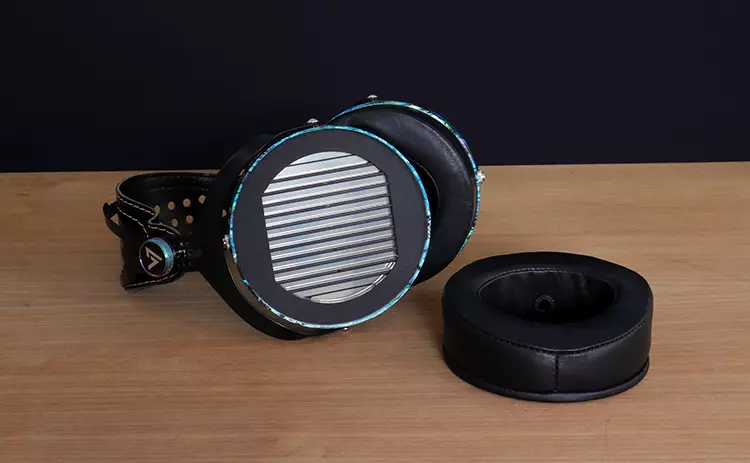
I’ve been a planar magnetic aficionado since the early days of the technology, and that’s what the Verum 2 uses. The driver is a custom, hand-rolled 90mm planar magnetic driver that sports a unique-looking magnet array.
When you remove the pads, you’re treated to a silver array of near mirror-polished flat magnets with narrow gaps and strips that act as fins upfront or waveguides.
I’m guessing that they help channel sound forward. and more than likely help out with driver refractions.
The driver’s double-sided magnet assembly is composed of N52 magnets pushing a 2µm membrane. The conductivity traces are silver and 0.5µm in thickness.
This combination of components gives off some interesting specifications, like an 8Ω rating accompanied by an SPL of 96 db/mW.
Design
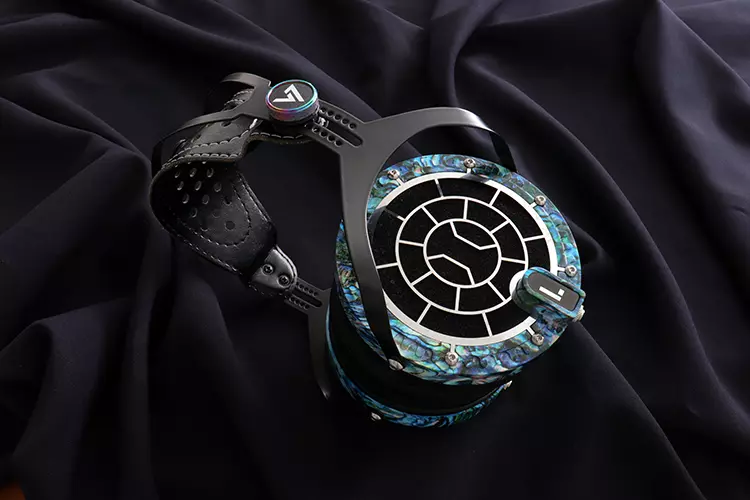
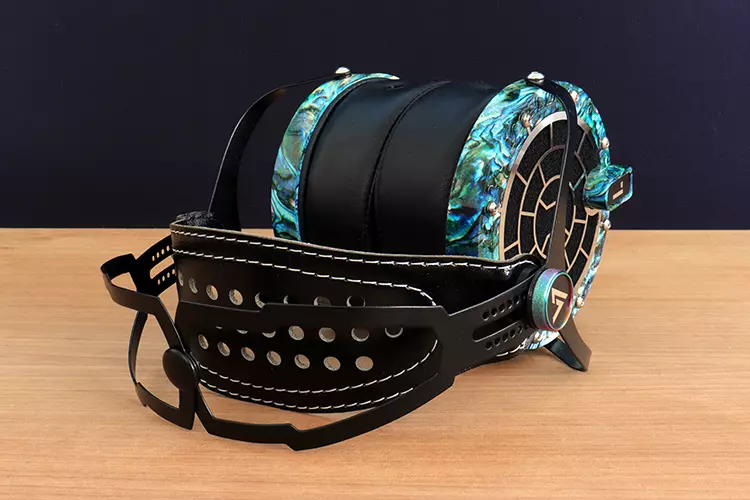
The Verum 2 uses a minimalistic design that uses fewer components comparatively, but that adds rigidity to the headband assembly.
For example, the yokes are part of the spring steel, and that makes them basically indestructible.
It’s also a hefty design for that and other reasons, and you would have to use lots of brute force to break something. Metal screws are used to attach the back grill and the yokes to the cups.
The cups are round, made with a resin, and portray a gear pattern. The electrical connections are pointing downward this time around.
The cups employ a mech-tech meets Cyberpunk vibe. I found some small evidence in these cups that makes me think they’re made on an individual basis.
From what I understand, there’s a lot of hand assembly involved in making the Verum 2, and we all know handcrafting is an almost lost art that adds value to any product.
The headstrap adjustment mechanism is directly attached to the upper part of the yokes and can be adjusted while wearing them. Many designs are such that I wouldn’t recommend such action.
The headstrap itself looks like it will last long, but I usually fit my headphones with headband covers anyway to further stretch their longevity. Thick white stitching contrasts with the black headstrap, which is held in place by two metal screws on each side.
I’m in doubt that the headstrap is made from pleather and looks to be made from two thin layers of leather sewn together and vented with perforations for added comfort.
However, they don’t count on any padding whatsoever. But to be honest, that would probably stiffen them up and detract from comfort since the strap, as is, is flexible and pliable.
Stock Pads
I’m going to throw out a theory of mine here. There are not many companies that vent their pads, but Verum Audio does. Why? There could be many reasons for that. Here’s why I think Verum Audio did this.
First off, planar magnetic drivers, when vented, tend to increase their bass output, which is a welcome trait since most lack slam, and a vent could help. This could aid in tuning the final sonic signature. But there are other reasons.
Have you ever put on a planar magnetic driver only to hear a sound like a crinkling or a crackling noise? That is the planar membrane being stressed by excessive air pressure when you first put them on, and that’s because they’re not vented on many occasions.
This could be a yet undiscovered remedy for the unexplained early failures of some early model planar driver membranes, since planar drivers tend to fail before dynamic drivers do. But at present, that gap is a distance by a nose, as they say.
Besides getting two vented sets of pads, they use a magnetic attach setup that I also highly advocate.
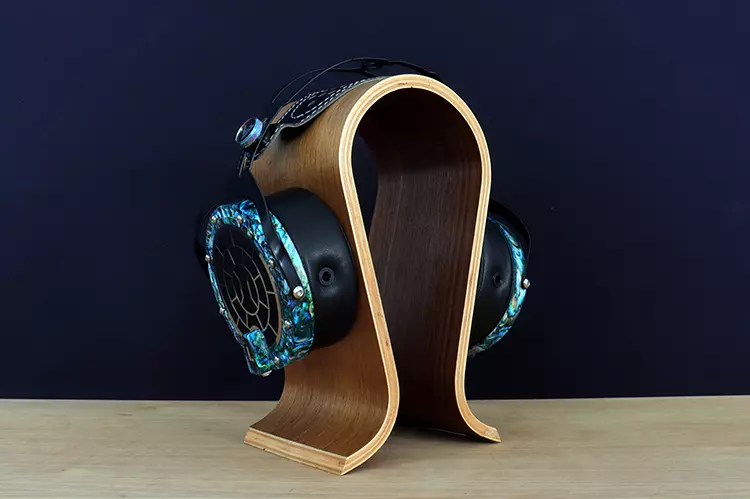
The pads are large, angled pads and resemble the old Brainwavz angled pads, with improved quality, of course, because these are made of leather, and fatter, medium-density cushions that are quite comfy to wear.
Comfort
The Verum 2 has an adjustable swivel and a metal spring angle adjustment on top that helps with comfort levels since the cups do not articulate.
This is something similar to what the Abyss AB 1266 has on its headband assembly, which, as you know, is an ultra-high-tier model.
The cups are fixed and only move slightly due to the natural flexing of the spring steel. They spin at their mounting point, and that’s it.
A properly arched headstrap adds comfort and is mounted directly on the metal headband and incorporates an 8-step adjustment implementation on the fixed, solid piece headband metal spring with integrated yokes.
At first glance, you would think that the Verum 2 would be clampy because of all that spring steel. But Verum Audio chose the right spring steel with just the right amount of clamp, without giving you that loose feeling fit.
I wore the Verum 2’s for hours and never felt discomfort of any kind. At times, I would wear them at my desk for hours with no sound and forget that I had them on.
Yes, these are comfy to wear, especially with the hybrid pads that use cloth instead of vinyl on the outer surface of the pad.
Stock Cable
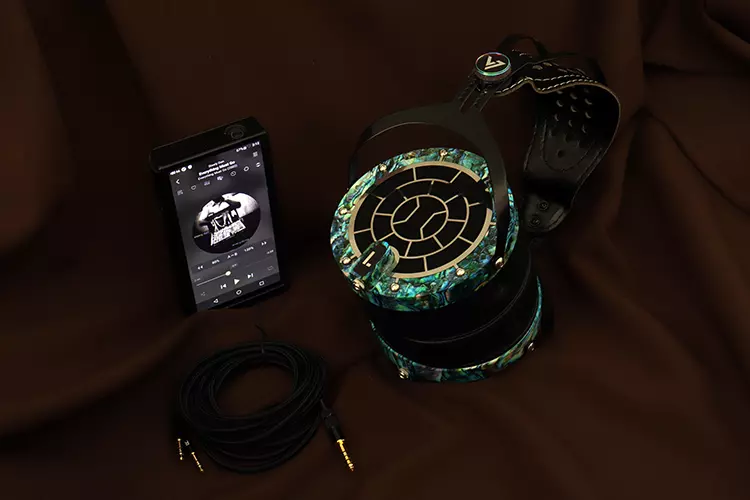
The title should have said ‘stock cables’ because the Verum 2 comes with, you guessed it, two cables. One is a dual thick, rubber-coated 3.5mm terminated with dual 3.5mm connectors, which is what the cups use for connectivity.
The second cable is a thinner, cloth-covered, 4.4mm balance cable that uses the same gold-plated black case tips, with white L and R letters that contrast, making it easy to identify each side. To be honest, their quality is quite generic.
But I am happy that they use the 3.5mm connectivity because it’s the most common type of connectivity today, and there’s a plethora of custom cables that you can purchase out there to further enhance your experience. They use the common tip positive, sleeve negative polarity.
I’m unsure if the cables are silver or copper-stranded. But to be honest, I prefer the warmth of copper over the brightness of silver. I think copper is being used here, but that’s just my unverified guess, and my sonic intuition tells me so.
Packaging & Accessories
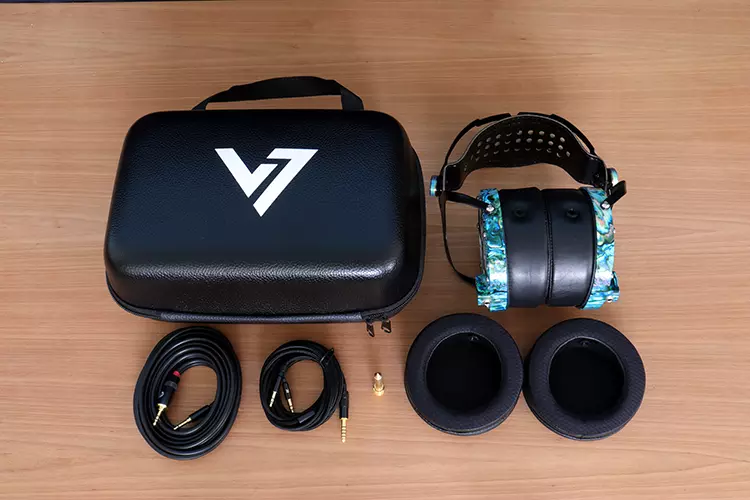
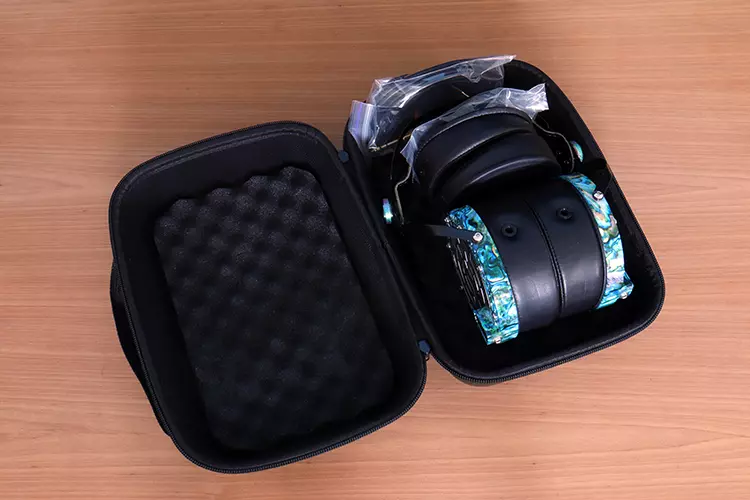
Besides the two stock cables and the 6.35mm adapter, giving the buyer three-way connectivity out of the box, the Verum 2 comes with a hard carrying case with the company logo proudly displayed in white upfront over the all-black case.
One observation I made about the stock cables themselves is that the website mentions them being 6-footers. They’re a bit longer, 6.6 feet to be exact, and that’s being generous. Most times, I find that cable makers cut cables as short as possible to cut costs, but not Verum Audio, it seems.
You also get a second set of pads, which differ in construction material. Both vented pads are made of leather, but the second set is a hybrid made with leather and cloth.
Sound Impressions
I used my usual desktop setup consisting of the SMSL SU-X and SH-X combo. I’m highly familiar with this combo’s sonic signature now and use it as a reference, not that they’re the reference standard.
I did use a few other components like the Shanling UA7, my trusty FiiO M11 Pro, the iFi Audio ZEN CAN 3 and ZEN DAC 3 combo, plus the stock Meze Audio dongle that comes with the 99 Classics Gen 2, to test a low-powered amplifier and gauge efficiency.
Summary
I started testing the Verum 2 by running the set through my routine tone sweep test and noticed some peaks. My ears heard a medium-sized peak at 2 kHz, a smaller peak at 5kHz, and an even smaller one at 7kHz. It seems lots of manufacturers are emphasizing the 2k area.
That small amount of elevation in that region gives the Verum 2 a slight mid-forward character that brings forth midrange detail, and Verum Audio tuned that area so as not to push the boundaries and become too ardent or overpowering in that region, or any other, to be honest.
I did feel that my Verum 2 set was on the intimate side, but musical overall with a sliver of an emotional aspect. The planar driver inside the Verum 2 provides some warmth, and most of all, an uncommonly meaty bass response.
They don’t provide a sterile environment, studio-like presentation, but what they produce is a fun listen, and one that keeps you interested by sounding balanced, smooth, and with a good amount of detail in the mid/treble area.
Bass
The Verum 2’s bass response is highly effective at 25Hz and above, and below that point, it fades away and drops gradually until it becomes ineffective below 20Hz, avoiding subsonic frequencies. But the bass response is also free of boominess or bloatfulness.
It tends to be midbass-friendly or favorable of that area of the bass since there’s lots of presence in that particular frequency range, but not in an overly done way.
This characteristic just adds more punch and slam, which is uncommon with most planar cans since they can only supply an audible experience.
The thing is that if you’re not afraid to engage some bass boosting with an EQ, then you will find that they can also take a considerable rise, transforming the bass into a visceral experience that supplies plenty of punch and kick.
Not at bashead levels, but with bass that’s deeply enjoyable, no pun intended.
If you like that sort of signature, in that the bass becomes visceral and hefty, you can go for it with the Verum 2, because the midrange is not affected by any bass frequency, even if boosted.
It seems that the Verum 2 is a flexible headphone that you can easily mold its sonic signature without affecting neighboring frequencies. But I felt the stock tuning was just right.
The bass response does have this character in that it tends to wander and often becomes omnidirectional, and then often times it’s focused and tight. I’m almost certain this is related to recording quality, and the Verum 2’s are revealing that sensation that I’ve rarely heard before.
The bass response is also speedy and responsive, but I would not consider it the highlight of the sonic signature since the bass is well balanced with the rest of the spectrum, and does not leave the listener unsatisfied, even in stock tuning.
Midrange
The midrange has a slightly vivid and forward character, and it’s probably due to the few peaks I found in the upper range of the mid frequencies. Don’t get me wrong, the peaks are not massive, at least audibly.
I did observe a particular characteristic of Verum 2’s overall sonic signature in the midrange. That is, even though there are some peaks that most of the time would affect the listener more when they crank up the volume. Here, that’s not so.
Even at high volume levels, the midrange remains smooth and engaging. Pitch is unaltered at high volume levels as well. These are good cans to rock out to because of that, but they can also portray a delicate side and a relaxed tonality at low or medium volume levels whenever you desire.
Vocals tend to be projected inwardly, giving vocals an intimate character, but they also come across as natural in timbre. The same goes for instruments, and they’re also portrayed with good separation between each element.
The Verum 2 is technically capable and produces fast-acting transients that produce lots of fine detail within the midbands and cater to those whose preference is midrange clarity and a natural forward midrange presence, or the front stager.
Treble
Most would assume that since the drivers are planar, the overall treble would more than likely fall into bright-sounding territory, but I found the highs to be quite relaxed and easy going on the Verum 2. I wouldn’t consider them as sparkly, but modest, more so.
They are produced with lots of detail, but the tuning allows the highs to come through restrained enough as not to become sibilant, plus they present the same characteristic as the midrange, in that even at high volume levels, the highs do not become piercing and remain under control.
The high frequencies remain right below the mid frequencies in output, but sound quite balanced with the overall spectrum while listening to music, which will sit right with people who are too sensitive to high frequency excess.
The Verum 2 tends to be fluent rather than harsh and is less aggressive and free from metallic edginess. It’s a high-frequency section tuned for long listening sessions that, by using sonic leverage, avoids fatigue to the listener’s benefit.
Staging & Dynamics
The Verum 2’s have what I call a realistic amount of width, but they’re not ultra wide-sounding. Heck, I would also say that depth is not produced profoundly on this set since nothing stands out in front of the listener that is too far out in front.
What the Verum 2 does well is imaging. I popped in Rick Wakeman’s “The Warning” from No Earthly Connection, and in the middle of the track, where the vocals go into a chorus repeating “language of the world, the missing sense,” the sound was circling my head, which was the exact recording engineer’s intent.
I would consider their soundstage in general intimate and engaging because it doesn’t lack placement accuracy, or does it lack microstaging, or what I call well-defined aural placement, but elements are placed within reach.
The Verum 2 can project sound with accuracy, but they keep it all within a triangle with some girth, and mostly maintain themselves within a straight plane, and don’t project high or too far forward.
Vocals tend to linger close and upfront instead of being produced far in front of the listener. This characteristic gives the Verum 2 an intimate sound sticker on top of the inward placement, and a near-field sense.
Click on page 2 below for my recommended pairings and selected comparisons.
Related Posts

iFi GO Link 2 Portable DAC/Amp Review: What’s New In V2?

The Grell OAE2 Headphone Review: Stereo Sound Made Easy

TinHIFI T6 Review — Headfonics

Hifiman Arya Wifi Review – Headfonia

LUXEAR Valor Review – Headfonia

JBL Soundgear Clips Review: Everyday Sound, Now in Style!

What’s New in the 64 Audio TWELVE Ti Special Edition?

AFUL Performer 8S Review — Headfonics

Meze Astru Review – Headfonia

Aful Performer 8S Review – Headfonia

Best Gear & Recommended Buys
