
Blog
FiiO EH13 Review — Headfonics

[ad_1]
Lynn reviews the FiiO EH13, a new set of wireless closed-back noise-cancelling 40mm dynamic driver headphones with LDAC support. It is currently priced at $49.99.
Disclaimer: I received this sample in exchange for my honest opinion. Headfonics is an independent website with no affiliate links or services. I want to thank FiiO for their support.
Click here to learn more about the FiiO audio products previously reviewed on Headfonics.
This post follows our current scoring guidelines, which you can read in more detail here.
FiiO EH13 Review
Summary
Sound-wise, the FiiO EH13 closed-back wireless headphones presents a competent signature, with a better top end countering the lack of sheer grunt down low. A somewhat expansive soundstage helps to keep the music lively and presentable without becoming boring or grating if you go the other way.
Performance & Features
7.9
Pros
Treble extension is a definite positive without becoming grating.
Portability makes this a traveler’s delight.
The midrange presents a solid foundation for either end to build upon.
Cons
Comfort after two hours became suspect due to the ear cup shape.
No case or cloth bag is included.
I have reviewed many wireless FiiO products over the last several years here at Headfonics, including the SP5 and the BR15 R2R, and they all see regular use in my systems.
I also appreciate the challenges FiiO has met head-on when designing multiple sets of headphones.
Since the SNOWSKY Anytime BT headphones, FiiO decided to widen the range with new competitively priced alternatives: the EH11 retro on-ear headphone, and the $49.99 EH13, reviewed here, all under their own main brand label.
The EH13 is a closed-back wireless headphone running BT6.0, with LDAC and AAC decoding capability for those from the Apple persuasion (guilty).
An affordably priced unit that brings FiiO’s technology and headphone experience to a wireless headphone? Sign me up. But how does it compare to budget offerings such as the Kiwi Ears Aventus and MOONDROP’s Edge? I found out in my full review below.
Features
A 40mm dynamic driver that is surrounded by a sapphire-coated dome diaphragm is usually associated with a higher-priced product. So, the EH13 is off to a good start.
The PEEK+PU surround finishes the driving unit off for rapid response to musical changes. Reducing potential distortion by 30%, giving a “delicate, detail-rich treble,” according to FiiO’s own literature.
The surrounds also help to reduce negative pressures during ANC, lending to a potentially more realistic sound presentation.
Using an optimized microphone array, complete with a DSP algorithm, the EH13 compensates for the audio signal in real-time. This not only keeps the sound stable, but presents it as rich, with crystal-clear vocals in both ANC-on and ANC-off scenarios.
While ANC certainly quiets noisy backgrounds, the panacea is usually degraded audio quality. FiiO’s approach helps to minimize that degradation while keeping ANC high.
A full parametric EQ can be tailored for the user through the updated FiiO Control App.
BT6.0 highlights the wireless technology, with the ability to play hi-res LDAC and SBC, along with AAC for Apple users. -42dB active noise cancellation is right up with the best out right now, and functions without hindering audio quality for such a noticeable drop in external noise.
In both wired and wireless modes, the EH13 provides Environmental Noise Cancellation (ENC) for use with phone calls, and you still get the benefit of an ANC-type of external noise suppression.
All of this is done with up to 75 hours (45 hours with ANC engaged) of battery life. A full charge only takes two hours, too.
As is common nowadays, the EH13 can connect to two devices (multipoint), allowing you to listen on your laptop and answer calls from your smartphone without issue.
Design
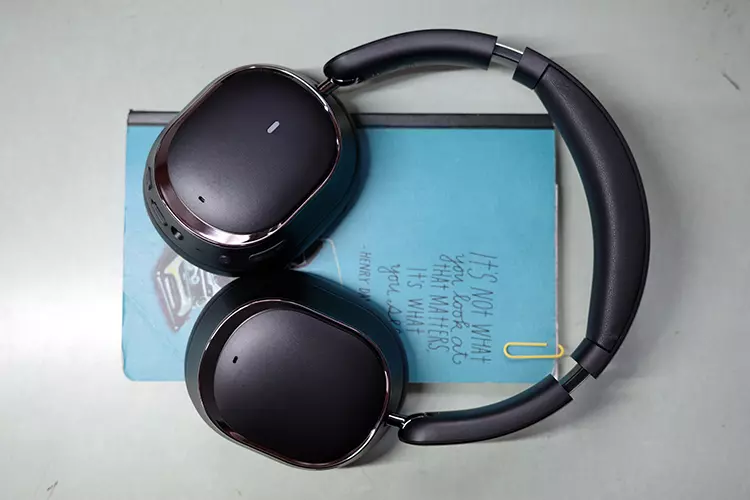
The EH13 is foldable, making it quite compact for your backpack. No case is included, and I wish a cloth bag had been included to prevent marring. FiiO has also been known for its build quality, which ranks right up there at the top.
The EH13 follows suit with tight-fitting plastic construction and subtle (no, really) chrome accents around the external side of the ear cups. This is a very tasteful design, without becoming simply another boring, black, or gray wireless headphone.
Adjustments of the headband straps extend from mid-way up the headband, complete with numbers and lines for reference. Neither the shiny headband nor the ear cups gathers fingerprints, either. A definite plus.
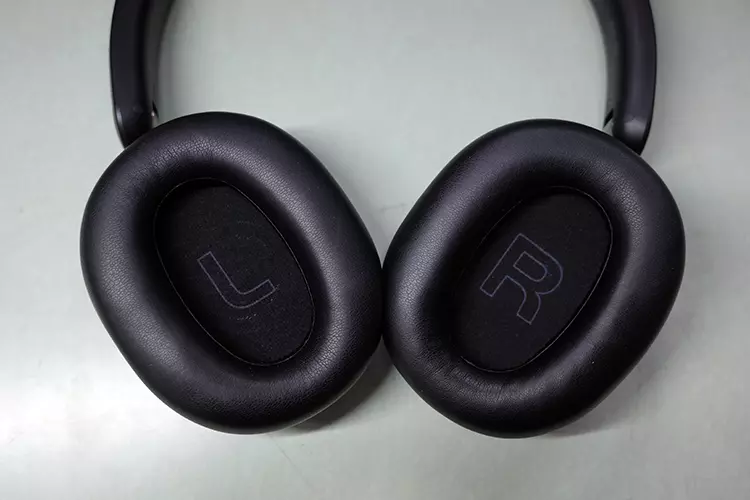
The pleather earpads did not come off with a gentle tug, so I left them alone. They did become warm while wearing, even on this cold 20F degree day. Construction was on the looser side but could be accounted for by the adjustment of the headband’s ease of use.
The ability to fold both cups inward made for a small, competitive look to it, and fit quite easily into my backpack amongst my other items.
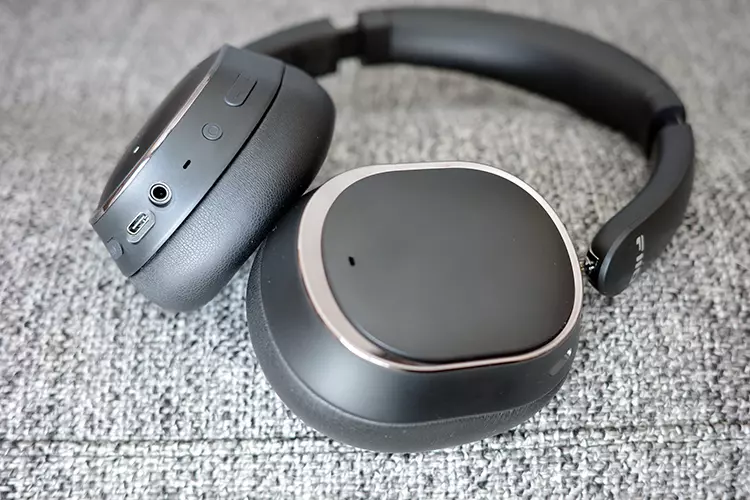
All the controls are on the right cup, and while immediately intuitive, they are placed in a less-than-ideal location.
When accessing those controls via your right thumb, they can be accessed, but the angle of attack makes it difficult for me. The differentiated shape of those buttons helps make usage quite good in the end.
But, as others have mentioned, the female voice used when changing between ANC on/off and transparency, is to put it politely, TOO DARN LOUD! Make this changeable within the app, please, FiiO.
Comfort & Isolation
The oblong earcups are comfortable, but I found that after 2+ hour sessions, the pressure from the pads on my ear reflected the narrowness of the opening.
The pads are comfortable, but that narrower opening in the up & down axis did not allow my ears adequate breathing room and hence put pressure on them. Especially when I had my reading glasses on.
Adjustability of the stanchions and headband is quite good, though, with numbers reflecting how far out the headband is on both sides.
Isolation when no music is playing is decent, but not like a closed-back headphone might be.
ANC
The ANC technology reduces ambient noise by about -42dB, but I can still hear my keystrokes when music is playing. Not by that much, but slightly noticeable. When the music is softer, the external pecking can be heard quite easily.
Moving between ANC on and off, there is quite a noticeable difference, as expected, and transparency mode does in fact work, allowing external noises to come in as they should.
But FiiO, please lower the volume of the female voice denoting changes between the three modes. It is so loud that I must take the headphones off before each change.
Controls
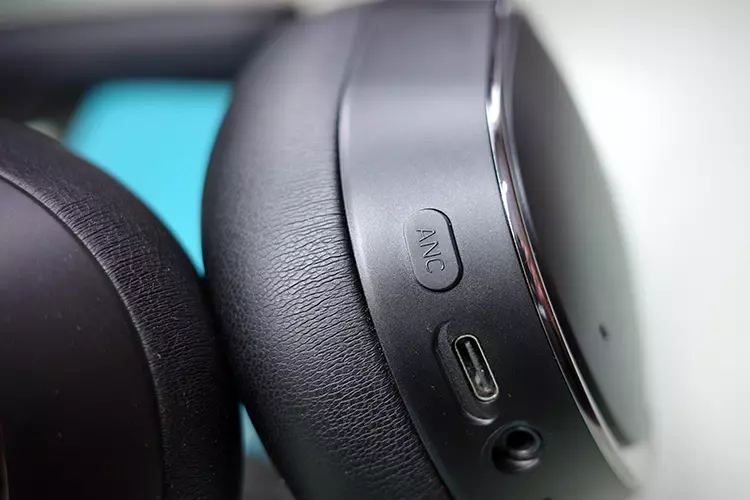
As mentioned above, all controls lie on the right earcup. Moving from front to back, you have an oblong volume +/- toggle, which mimics the shape of the earcup, followed by the on/off button and one of the volume slots.
Next, you have the 3.5mm AUX connection for wired use, and the USB-C port for charging. You can both play and charge simultaneously. Last is the somewhat oblong ANC button for use when manipulating between ANC-on, ANC-off, and Transparency modes.
Aside from the extremely loud voice on the ANC change and the less-than-comfortable angular access of the buttons, the functionality of the EH13 is quite good.
I appreciated the differentiation of shape between the buttons and rarely found myself doing something besides the intended task.
App
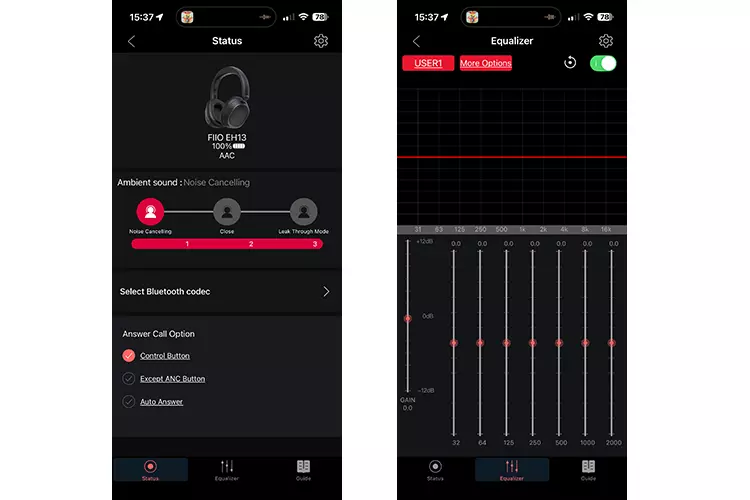
FiiO’s Control App has gone through a few iterations, with minor aesthetic changes. Functionality has been improved, and access to the parametric EQ is as easy as clicking on the Equalizer button in the bottom center.
As with other FiiO wireless-capable items, you can bring your custom EQ settings across to the EH13 if you have a FiiO account. Otherwise, you can change the 1-bands +/-12dB, as well as the gain of the same amount.
You can update firmware for the EH13 under the cog settings button in the top right.
Battery
With a run time of up to 75 hours with ANC off, and 45 hours with ANC on, there is no lack of sustaining power.
I can confirm both are fairly accurate, running ANC-off for 70 hours (the first run and burn-in), and 43 & 45 hours, respectively, with ANC-on subsequently.
Packaging & Accessories
The FiiO EH13 comes in a simple boxed package, with a slide-out plastic tray holding all the goods.
The headband was wrapped in a synthetic protective material, while open plastic bags protected the ear cups, which faced up. Unfortunately, the two together rubbed permanent spots onto each cup. While minor, this was still annoying.
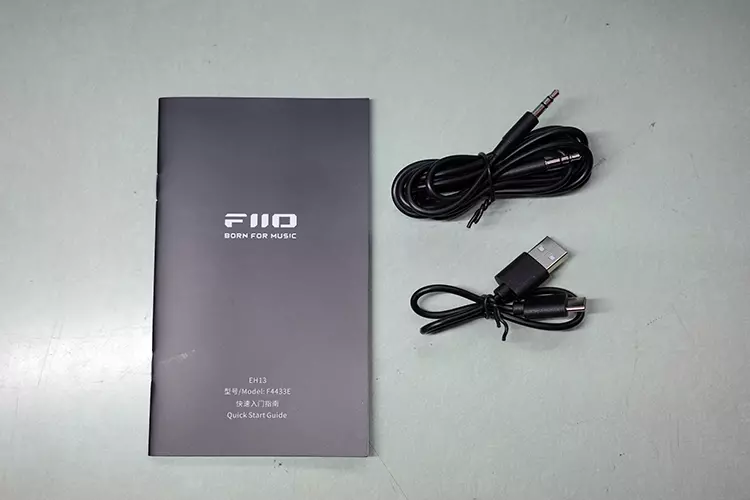
A 3.5mm AUX cable and a USB-A to USB-C charging cable are also included, along with a multi-language manual that is quite thorough.
I do wish a cloth pouch, or bag, had been included for protection, but I understand the lack at this market level.
Sound Impressions
All critical listening was done using the “Standard” EQ, and after 75 hours of burn-in. That burn-in time was also used to evaluate battery longevity for both ANC on and off testing, hooked to the FiiO xJade Audio JM21.
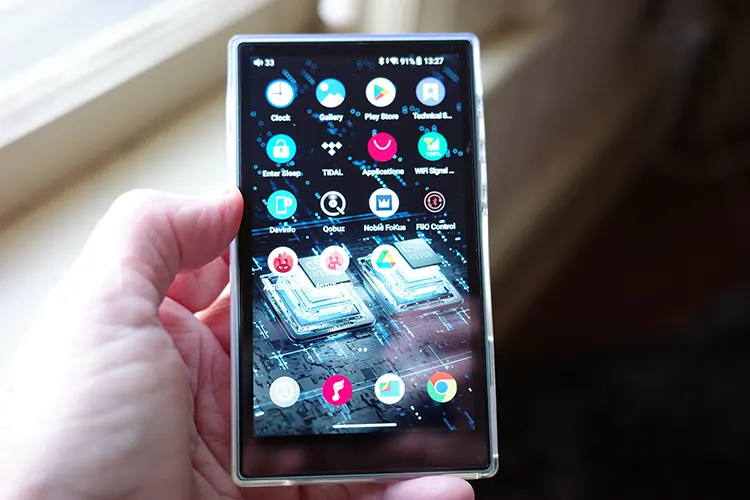
Listening was done using my iPhone 16 Pro Max and JM21 exclusively. Comparisons were made to the Moondrop Edge, Sennheiser ACCENTUM Plus, and Kiwi Ears Aventus.
Summary
The EH13 presents a slightly upward tilt to the signature, with a treble push brightening the load. Bass is not shy, but more reliant upon the source than the 40mm driver. Bass is not lacking, but rather dependent upon source material as a result.
This vibrant nature of the top end extends into the midrange with good placement of instruments, even if a bit thin in note quality.
Detail retrieval is good, but the lack of note weight gives a thinness to the signature that can be defined as good clarity of note, without becoming ponderous.
When using the FiiO Control app on my iPhone, I could dial in bass and mid note weight when needed, but kept the signature flat for the testing.
Bass
While not thunderous, the bass lies more on the polite side, which can favor genres that prefer the bass to be part of the whole rather than the show.
I found that when adding bass via EQ, for informative purposes only, this lack of low-end could be countered without too much trouble.
When the source provides more oomph to the low-end, that bass is slightly loose with less control than I would prefer, overshadowing the midrange, while bleeding into the lower mids.
For genres that prefer a deeper reach, EQ’ing or using source music that provides such ambiance in sound work, but without the level of detail one might like.
Mids
Presented singularly, the midrange, especially instrumentation, comes across as succinct with good control. Levels of detail are good, but clarity is more a part of the whole than individually.
The midrange sits directly in front of the listener, without lifting or extending in such a manner as to draw the back part of the stage too far forward.
Vocal performance comes across as distinct, but with a thinning quality that plays into the overall signature.
Mind you, the sound is still quite decent, but without the note weight one might prefer when asking for not only spatial dimensionality but girth in the three dimensions, too.
On the upper end, the midrange does not bleed into the treble notes, melding better than the low-to-mid end of the signature.
Punctuating notes in the midrange can be a bit too forceful, which can be attributed to the thinning character of the overall signature.
Treble
The reach at the top-end is quite good, without any semblance of sibilance. Extension is punctuating rather than rounded, which may not be to everyone’s liking, but allows for that extension to give notes room to expand. At the cost of note weight, again.
A commonality across the sound signature of the EH13 is a thinner note quality, but this should not be noted as too detrimental.
Rather, that thinning quality affords the listener an easier sound with which to listen, without too much burden in extension at both ends.
The extension up top does allow for good airiness across the whole signature, which does aid in positively separating the sound qualities.
Staging & Imaging
With the midrange pushed slightly out front, one might think depth suffers, but this push presents an additive effect in that dimension. The width extends slightly beyond my ears, but not in such a manner as to disenfranchise instruments from each other.
Instead, the three-dimensionality sits on a cozier level, but without feeling claustrophobic. There is adequate space for instruments and their corresponding notes to spread out, thanks to this and the treble extension.
The spatial workings afforded good placement of instruments in the fore/aft and right/left dimensions, but not as definitively as higher-level offerings might. The spatiality was quite adequate for the EH13s, though.
While not level-defining, the EH13 presented an accuracy that worked in concert with the sound signature to present a straightforward response to the source music.
Click on page 2 below for my wireless performance impressions and selected comparisons.
[ad_2]
Source link
Related Posts

Auribus Acoustics Sierra Review – Headfonia

Effect Audio Ares 10 Review — Headfonics

Grell OAE2 Review — Headfonics

MOONDROP MOONRIVER 3 Review — Headfonics

PLUSSOUND Copper Fusion Hybrid Review — Headfonics

Beyerdynamic MMX 230 Headset Review: A New Gaming Champion!

Audeze Maxwell 2 Review – Headfonia

ThieAudio Hype 4 MKII Review

TWISTURA Beta Review — Headfonics

The Auribus Acoustics Sierra Reference Headphones Review

Fosi Audio BT20A MAX Review — Headfonics


