
Blog
TWISTURA Beta Review — Headfonics

[ad_1]
Meldrick reviews the TWISTURA Beta, a new single 11mm dynamic driver universal in-ear monitor featuring a triple nozzle tuning system. It is currently priced at $119.
Disclaimer: This is a sample in exchange for my honest opinion. Headfonics is an independent website with no affiliate links or status. I thank TWISTURA for this opportunity.
Click here to read more about TWISTURA audio products previously reviewed on Headfonics.
This article follows our latest scoring guidelines, which you can read in more detail here.
TWISTURA Beta Review
Summary
The $119 TWISTURA Beta makes a decent impression as an affordable single dynamic driver IEM, thanks to its glass composite dynamic driver and three-nozzle tuning system. It excels in clarity, imaging, and instrument separation, delivering a detailed, forward-sounding presentation that rewards attentive listening.
Pros
Good imaging performance.
Versatile nozzle tuning options.
Cons
Can sound sibilant at times.
Requires warmer amplification to perform its best.
TWISTURA is a relatively new name in the Chi-Fi space, having only emerged around, releasing IEMs like the D-Minor and the Woodnote, the latter of which gained praise for its wood fiber composite diaphragm.
Now, TWISTURA steps up with the Beta, positioning it as the brand’s current flagship dynamic driver IEM.
The Beta centers on an 11mm driver featuring an unusually proprietary planar glass composite diaphragm and is priced at $119.
This places it in direct competition with tunable single-driver alternatives such as the LETSHUOER S08, the Topping Arpegear Hane, and the Hidizs MP143 Salt.
To find out whether the Beta’s ambitious driver technology can hold its own against this diverse field of competitors, read the full review below.
Features
The Beta is built around an 11mm dual magnetic dual cavity dynamic driver featuring a planar glass composite diaphragm, an unconventional material choice at this price bracket.
The glass layer is said to allow faster transient response and better clarity compared to more conventional PU, LCP, or beryllium-coated diaphragm materials.
Complementing the driver is a modular termination system that includes both a 3.5mm single-ended and a 4.4mm balanced plug, a feature that is increasingly expected at this price point but remains far from universal.
The inclusion of both plug types out of the box means users can take immediate advantage of balanced sources without purchasing an aftermarket cable, adding practical versatility that aligns with the Beta’s positioning as a daily-use flagship.
The standout feature of the Beta, however, is its three-nozzle modular system. The Standard (silver), Vocal (gold), and Instrumental (black) nozzles offer meaningful adjustments to the sound signature, primarily targeting the mid and treble regions.
Unlike many nozzle systems that deliver only subtle shifts, the nozzle changes on the Beta are pronounced enough that they essentially constitute three distinct listening experiences within the same IEM.
Design
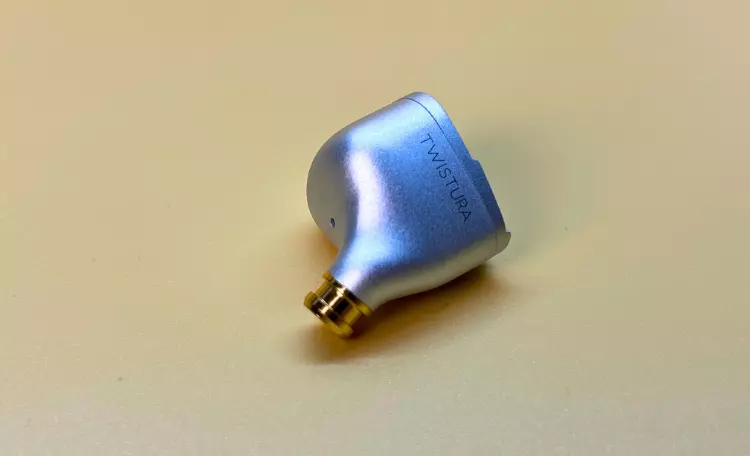
The Beta’s shell is machined from aerospace-grade CNC aluminum alloy using a five-axis process, resulting in a noticeably solid, premium feel that exceeds the IEM’s $119 price.
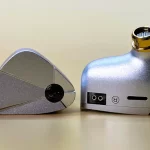
The Beta comes in a 2-piece design with a separate faceplate and shell, which are fused expertly with a barely visible seam that I can barely feel while running my finger through the IEM.
The shell has a rounded, irregular triangular form factor that fits around the ear well, with diagonal lines running across the faceplate and a black plastic TWISTURA logo positioned off-center in a clean, understated manner.
The surface receives a brushed finish with careful edge work, giving it a look closer to a mid-range offering than a budget flagship.
The faceted faceplate design catches light attractively without resorting to flashy colorways or loud graphics. It is restrained and functional in its aesthetic.
The nozzles are interchangeable via a threaded connection, and the IEM uses a recessed 0.78mm 2-pin connector system for cable attachment. Right beside the 2-pin connector, a long, thin exposed slot highlights the IEMs vented design.
The nozzle mechanism itself feels reassuringly solid, with no wobble or imprecision when swapping between the three included filters.
At approximately 6 grams per shell, the Beta is impressively lightweight for a full-metal construction IEM, which has a direct positive impact on comfort.
Comfort & Isolation
According to TWISTURA, the Beta’s ergonomic design draws on extensive ear shape data, and the result is an IEM that sits naturally and securely in the ear with minimal adjustment required.
I was able to wear the Beta for 3–4-hour sessions without significant hotspots or pressure buildup.
The smooth metal finish warms to body temperature relatively quickly, and the absence of any sharp edges means there is no discomfort even at deeper insertion depths. Comfort is genuinely one of the Beta’s strongest practical qualities.
Isolation is adequate for daily use. The vented dynamic driver design means the Beta does not achieve the same level of passive noise isolation as fully sealed designs like the Cadenza II.
However, it performs respectably, attenuating moderate ambient noise such as office conversations and low-level outdoor traffic without difficulty.
There is no meaningful pressure buildup during extended listening, which makes the Beta considerably more comfortable for long sessions than some sealed alternatives.
Stock Cable
The cable included with the Beta immediately stands out as one of the better packaged cables at this price point.
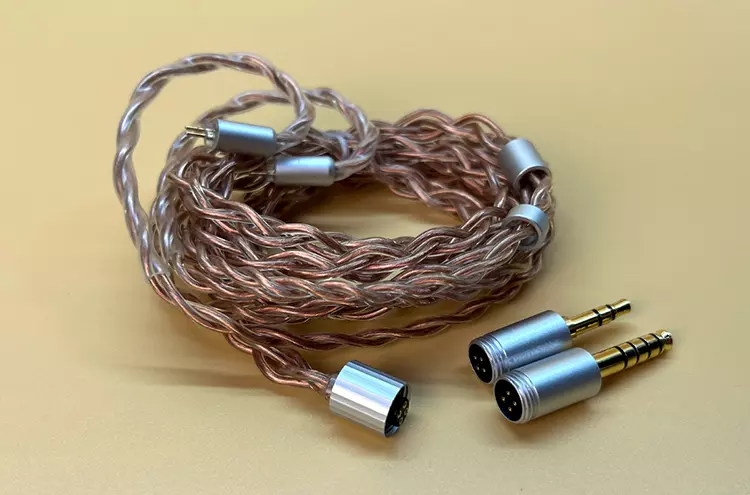
It is a 4-core oxygen-free copper (OFC) braided cable with a copper coloration that pairs naturally with the metal shells. The braided construction feels substantial and well-insulated without being unnecessarily stiff, striking a balance between durability and usability.
Microphonic noise is minimal. During both seated desk use and light movement, the cable remained quiet and managed well, holding its position without becoming an irritant.
The modular termination system includes both a 3.5mm single-ended and a 4.4mm balanced plug, both of which connect via a screw-on mechanism on the tip. The connection is firm enough that there is no concern about accidental detachment during normal use.
The modular cable is a particularly welcome inclusion given the Beta’s $119 price point, where many competitors still ship with fixed-termination cables. I
t allows users to switch seamlessly between single-ended dongles and balanced sources without needing to purchase an aftermarket cable upgrade, which meaningfully improves the Beta’s overall value proposition out of the box.
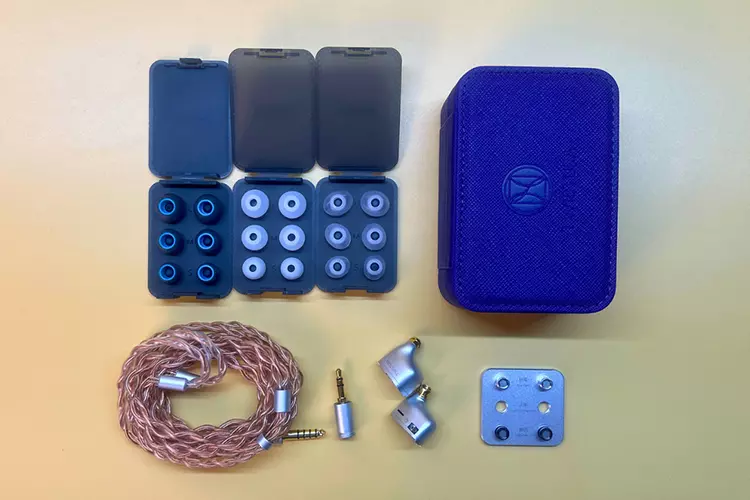
Packaging & Accessories
The Beta arrives in a well-organized rectangular box with a cardboard sleeve bearing the TWISTURA branding and an image of the IEM, along with key specifications and frequency response graphs.
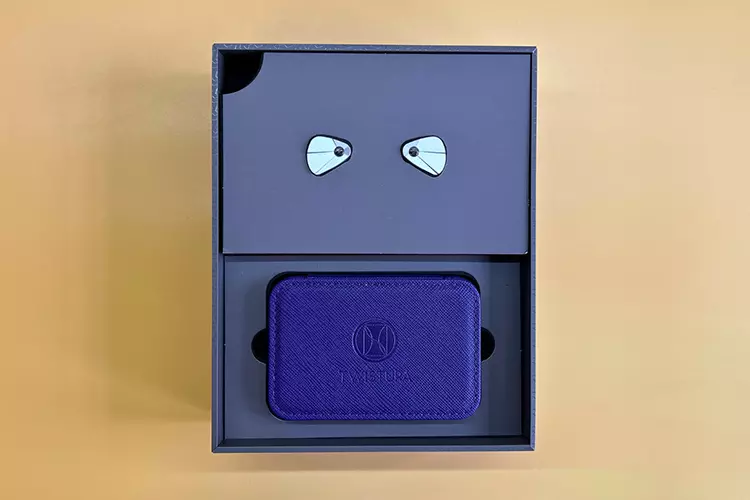
Lifting the lid reveals the IEMs nestled in foam cutouts, with a deep purple faux-leather hard case positioned prominently beside them.
The package includes:
- The Beta IEMs (1 pair)
- OFC 4-core braided cable
- 5mm modular plug
- 4mm modular plug
- 9 pairs of silicone ear tips across 3 styles (S/M/L each in dedicated plastic containers)
- 3 interchangeable tuning nozzles (Standard/Vocal/Instrumental) on an aluminum holder plate
- Deep purple faux-leather hard case with magnetic closure
- User manual and warranty card
The carrying case deserves mention. It is one of the more premium-feeling cases included at this price point. It is a firm, compact, hard case clad in textured faux leather with TWISTURA imprinted on the top and a strong magnetic closure.
It is spacious enough to fit the IEMs, the cable, all three nozzle filters, and a compact dongle, though it is too large for a pants pocket and best suits a bag or backpack.
Sound Impressions
Unless stated otherwise, all sound impressions were conducted using the stock cable with the 4.4mm balanced termination and the standard silver nozzle with large silicone tips.
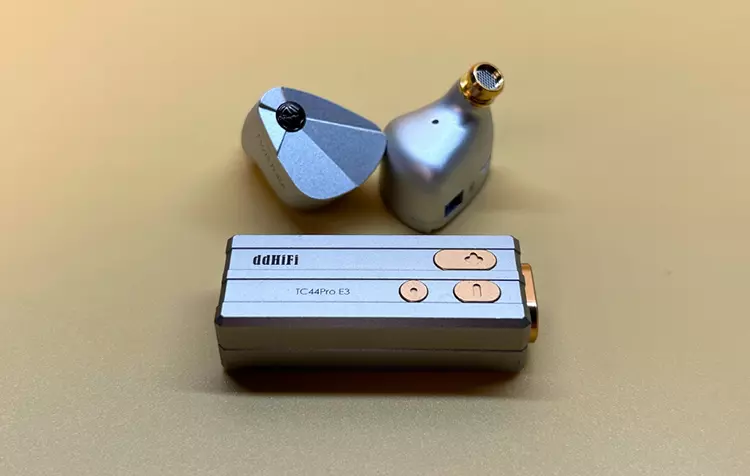
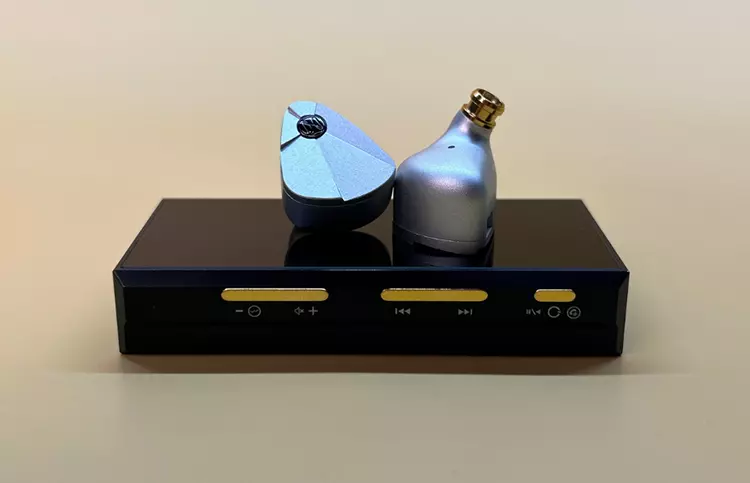
I paired the Beta with the ddHiFi TC44 Pro E3, the iFi audio ZEN DAC, the 7Hz Artemis39, and FiiO’s K13 R2R desktop amplifier.
Bass
The Beta’s sub-bass is one of its more immediately notable qualities. It hits with genuine authority and depth, delivering a physical sense of impact that suits genres that demand it.
In modern hip-hop and R&B tracks, this sub-bass presence is satisfying and immersive, though it carries a minor degree of bloat and a slightly blunted tone that prevents it from sounding fully taut or articulate.
It does not bleed excessively into the lower midrange, but the sub-bass texture is not as clean or defined as more neutrally tuned alternatives at this price.
The mid-bass, by contrast, is less of a focus. Bass guitars and lower-register instruments carry somewhat less body and roundness than on warmer-tuned competitors.
Snare drums illustrate this character clearly; they are reproduced with a crunchy, forward-edged quality that prioritizes attack over a more natural, organic tonality. It is not an unpleasant presentation, but it does lean more toward processed than lifelike.
Switching to the Vocal nozzle noticeably shifts the balance. The sub-bass recedes slightly while the lower mid-bass gains more elevation, producing a fuller, warmer low-end character.
It is a more forgiving presentation for those who find the standard nozzle’s sub-bass emphasis too prominent, though the Vocal filter requires more power to maintain good dynamics at louder listening levels.
Mids
The Beta’s midrange is defined by a forward upper-mid presence that prioritizes apparent resolution and detail over organic tonal accuracy.
String instruments are a highlight; they present crisply, with good harmonics and a dynamic quality that communicates texture and body well.
Acoustic guitar strums carry energy and presence, and the upper-mid emphasis means individual string articulation is easy to follow.
The trade-off is that this forwardness comes at some cost to naturalness. Acoustic guitars carry a slight edge or brightness in their upper register that favors perceived clarity over tonal authenticity.
Brass instruments are another area where the Beta’s forward upper-mid character makes itself known. They present with strong dynamics, good harmonics, and a resolving quality that gives them real presence in the mix.
However, higher-pitched brass instruments can develop a trailing sibilance in their upper registers that accumulates into listening fatigue over longer sessions.
This is not a constant characteristic, but it surfaces reliably on certain recordings and is worth noting for listeners who spend significant time with brass-heavy material.
Vocals are a more complicated story. The Beta’s mid-forward character does not translate directly into forward vocal positioning.
On the standard nozzle, both male and female vocals come across as slightly muffled, sitting a step back in the mix rather than projecting cleanly. Female vocals can take on a nasally quality in the upper midrange under certain conditions, which contributes to the overall sense of fatigue.
The Vocal nozzle addresses this most directly; it pushes vocals more forward and widens instrument separation around them, though it also recedes mid-range string instruments noticeably.
Treble
The treble is simultaneously the Beta’s most impressive and most demanding region. Electric guitar strums carry bite and sharpness, and high-end synths are more immediately apparent in the mix.
The Beta’s upper-frequency energy clearly favors genres where that kind of presence adds excitement and detail.
Cymbals are a genuine highlight, riding out with good decay and harmonics that feel natural and well-controlled rather than splashy or metallic.
The problem is consistency. Hi-hats are noticeably sibilant and resonant, and on poorly mastered tracks, this tips into genuine discomfort.
The treble congestion is a related issue. While individual treble elements can sound impressive in isolation, instrument separation in the upper frequencies is narrower than what more neutrally tuned competitors offer, and in busier arrangements, this congestion becomes difficult to ignore.
Multiple treble-range instruments competing simultaneously tend to bunch together rather than occupy their own distinct space in the mix.
The cumulative effect of the sibilant hi-hats, the resonant upper frequencies, and the compressed treble separation means the Beta can become fatiguing during extended listening, particularly on tracks that are already bright or dense in the high end.
It is not a dealbreaker in well-recorded material, and the standard nozzle keeps things more controlled than the Instrumental filter, but listeners who are sensitive to treble energy should be aware that the Beta demands some source and genre matching to stay comfortable over long sessions.
Imaging
The Beta delivers one of the strongest imaging performances available in a single dynamic driver at this price point.
The soundstage width is notably expansive for an IEM, particularly with the gold vocal nozzle, which enhances lateral staging more than either of the other two filters.
Instrument placement is precise, with well-defined spatial cues and a convincing sense of depth and layering in appropriately mastered recordings.
The glass diaphragm’s fast transient response plays a meaningful role here; note attacks arrive crisply and distinctly, which aids the perception of separation even in moderately complex arrangements.
In string-heavy and acoustic recordings, individual instruments are positioned clearly and maintain their distinct space without blurring into neighboring elements.
The imaging performance weakens somewhat in very dense, poorly mastered recordings, where the upper midrange and treble emphasis can cause individual layers to bunch together rather than spread naturally.
But for the genres and recording qualities the Beta is best suited for, its spatial presentation is a genuine highlight.
Click on page 2 below for my recommended pairings and selected comparisons.
[ad_2]
Source link
Related Posts

Auribus Acoustics Sierra Review – Headfonia

Effect Audio Ares 10 Review — Headfonics

Grell OAE2 Review — Headfonics

MOONDROP MOONRIVER 3 Review — Headfonics

PLUSSOUND Copper Fusion Hybrid Review — Headfonics

Beyerdynamic MMX 230 Headset Review: A New Gaming Champion!

Audeze Maxwell 2 Review – Headfonia

ThieAudio Hype 4 MKII Review

FiiO EH13 Review — Headfonics

The Auribus Acoustics Sierra Reference Headphones Review

Fosi Audio BT20A MAX Review — Headfonics


