
Blog
MOONDROP MOONRIVER 3 Review — Headfonics

[ad_1]
Louis reviews the MOONDROP MOONRIVER 3, a 3rd-gen dual CS43198 dongle DAC with integrated DSP and up to 500mW of output power. It is currently priced at $219.00.
Disclaimer: This sample was sent to me in exchange for my honest opinion. Headfonics is an independent website with no affiliate links or status. I thank MOONDROP and Shenzhen Audio for their support.
Click here to read more about the MOONDROP products previously reviewed on Headfonics.
This article follows our current scoring guidelines, which you can read in more detail here.
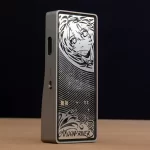
MOONDROP MOONRIVER 3 Review
Summary
The flagship MOONDROP MOONRIVER 3 dongle DAC has a bullet-proof sexy design that’s energy efficient, and throws in a wide-sounding, dynamic, and detailed sound signature.
Pros
DSP features add value.
Very low noise floor and versatile drivability.
Easy on battery life.
Cons
No gain control will seem awkward to some.
A bit hefty in weight compared to the previous version.
MOONDROP recently released its third-generation MOONRIVER 3 dongle, and I can tell on the surface that they have been hard at work to make this a competitive dongle in what has become a saturated audio category.
In past reviews, I covered the MOONRIVER 2 and the MOONRIVER 2: TI. I wasn’t that impressed with the MOONRIVER 2, to be honest, and I think what did it was the unorthodox body style it employed.
The MOONRIVER 2: TI not only sounded better, but the body style employed a pleasant boutique aesthetic and a quality build with obvious refinements in design.
The MOONRIVER 2: TI turned out to be one of my favorite dongles at the time, taking a spot in my top five dongle list.
The MOONRIVER 3 has something that caught my eye as I was reading up on it, and that’s the button labeled DSP. That’s something that turns this into an interesting product launch.
Let’s see how it performs and stacks up against its predecessor, plus the current competition, such as the Shanling UA7 and FiiO’s QX13, in my full review below.
Features
The major changes that took place within the MOONRIVER 3 did not occur with the DAC section, although some additional tweaks were incorporated within this model. It employs the same dual CS43198 used on the MOONRIVER 2: TI.
This configuration allows the MOONRIVER 3 to run PCM audio formats of up to 32-bit/384kHz bit rates, and DSD files at up to the DSD256 level of the particular format. No other formats are declared as working.
One major change that took place is that on this model, MOONDROP incorporated an app that lets you change the overall tonality via a sophisticated equalizer, with the ability to store settings and an added ability to share stored curves with others, and even load some from a large user bank.
Not only does MOONDROP have an app for the MOONRIVER 3, but they also created a web page interface that interacts with the dongle in many ways.
I really like the Monriver interface because it seems more powerful when it comes to sonic tweak capabilities and customization, plus the community-based preset bank is killer. It also has the power to drive many headphones since it’s rated at 4V 500mW max on the balanced tap.
I admit, I like coloration when it’s done right. The MOONDROP MOONRIVER 3 is one of the few dongles that allow you to customize what I call the end product in order to obtain a sound signature that pleases the user.
The sound-shaping features can also be used in a corrective manner as well, and not just for fun.
Design
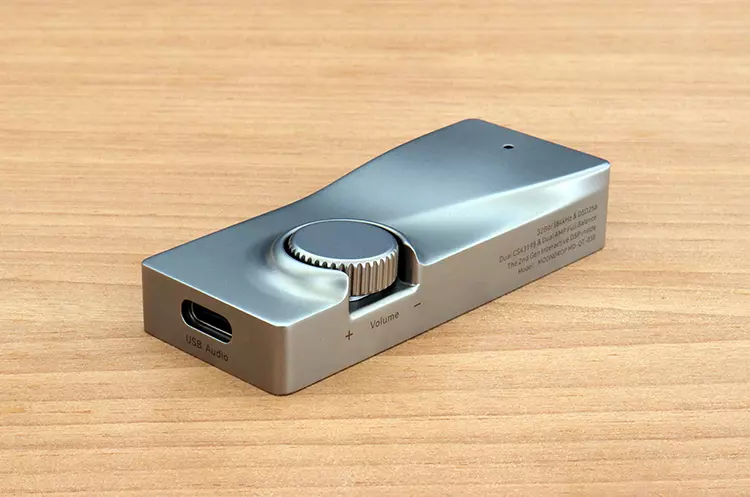
One of the major changes that took place on the MOONRIVER 3 is that this time the dongle is equipped with a multi-function rotary volume control that gives the end user a fine 100-step adjustment feature, and a push-to-activate feature.
To be honest, I am still fond of the MOONRIVER 2: TI’s body style, and although it was a fingerprint magnet, the overall design was more artistic to me. The MOONRIVER 3 is mechanistic, but the more I look at it, the more I like it.
This time, instead of titanium, MOONRIVER used precision-milled stainless steel for the main chassis along with a stainless steel, knurled, encased, sideways-mounted volume knob. Even the DSP toggle switch appears to be made of stainless steel.
The backside sports a see-through tempered glass that displays some MOONRIVER 3 Waifu artwork while simultaneously allowing you to view most of the internal components. I say most because some of the circuitry is covered by the artwork itself.
I/O
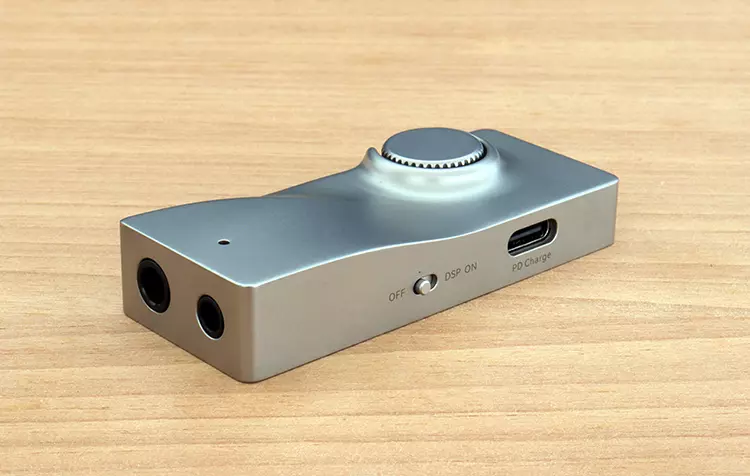
The MOONRIVER 3 does have some interesting IO features. MOONDROP incorporated two USB-C ports onboard, but the implementation doesn’t give us a turbo feature; it’s something else.
All this feature does is supply the end-user with a PD protocol charging port that supports up to 60 watts of charging power while you have the MOONRIVER 3 connected to your mobile device.
The feature has one huge caveat: you must use the supplied cable for it to work between your mobile device and the MOONRIVER 3.
I thought I was going to be slick and be the first to report that you can use your own cables with this feature, but nothing happened with my current cables. It was a no-go.
This feature also varies in power output by hardware, and you only get 25 watts of charging power when using an iPhone, and 30 watts max on an Android phone.
It’s an underwhelming feature, to be honest here, and I’d rather have a turbo feature, or at least for it not to be dependent on a particular cable to function properly.
Other than that, the rest of the IO is standard fare. Two headphone taps consisting of a 4.4mm balanced connection alongside a 3.5mm single-ended tap.
I do propose that dongle makers start making dongles with a TRRS 3.5mm that is capable of managing a headset microphone. Please?
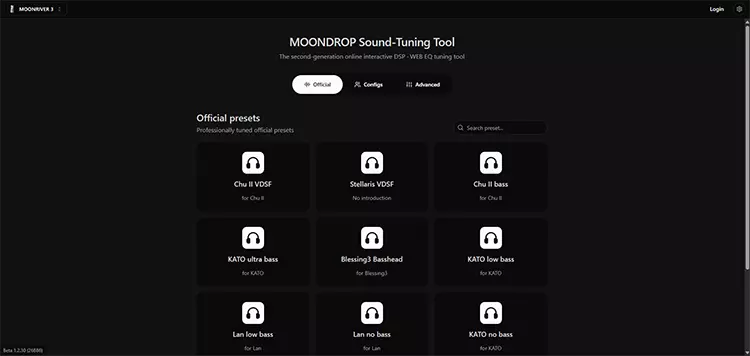
DSP Mode
I’m a sucker for features like this. When I found out what that DSP button on the MOONDROP MOONRIVER 3 led to, I almost popped a fuse.
Again, I like color, especially well-done color, because I am partially bored of listening to neutrality all the time. It makes music feel like work.
The downloadable app is just called MOONDROP. But they also give us a web interface that lets you select stored EQ curves from an official sound presets list, or configs from other users, but you also get a section that lets you make your own.
The DSP button ties it together in that once you load an EQ profile, either an official variant, from either the user-based bank or from your own, to activate it, you simply put the dongle in DSP mode. With it off, it defaults to the neutral factory setting.
The equalizer that is within the web interface is a complex one that uses ten bands and parametric adjustments that, once you have set just right, you can then store the EQ curve within the web interface or locally, and it even lets you share it with other MOONRIVER 3 users.
Lots of purists might not agree with me, but this feature is a game-changer.
Think of all the curves you can create and store. Some you can create just for fun, but you can also apply corrective measures to any headphone or IEM in your collection.
If you’re feeling quiescent, you can always look up and use another user’s curve for the same headphone.
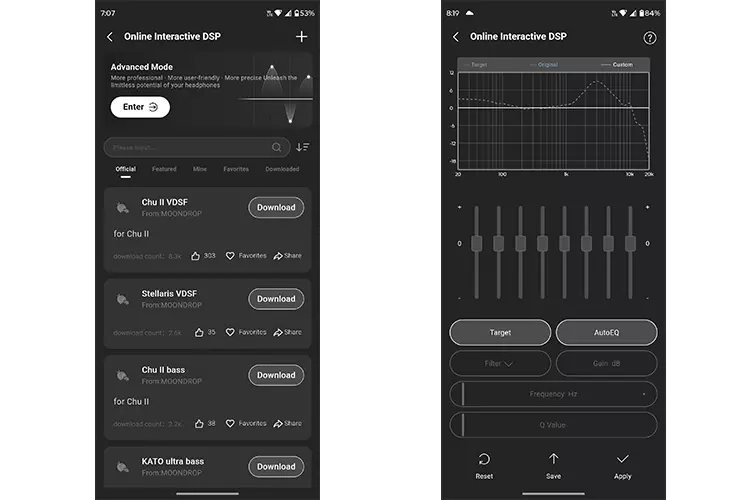
MOONDROP App
The MOONDROP app is just as complex as the web interface, or even more so. The main features are broken down into five sections, plus an advanced mode that allows you to access the complex equalizer to create profiles that can be stored and used later on.
The sections are called official, which is where you’ll find all the official MOONDROP EQ curves, featured profiles, favorites, downloaded, and mine, which is where the ones you create are stored. All these features are under the online interactive DSP section.
The firmware upgrade feature is upfront when you open the app, along with another feature called STI, or personal sound preferences, which is another location to store EQ curves.
What I did notice was that there was no gain control, or perhaps my eyes didn’t see one. It’s one of the only dongles out there that does not have a minimum of two gain settings, but it seems to do well without one.
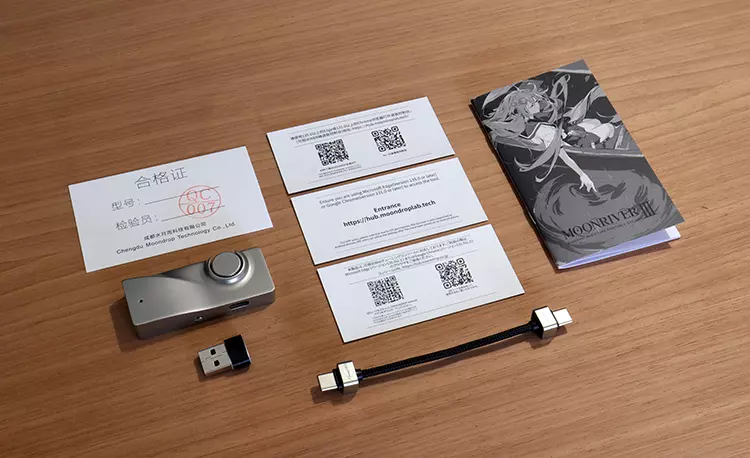
Packaging & Accessories
I did have a small snafu with the MOONDROP MOONRIVER 3 packaging, but it was eventually resolved. The dongle comes wrapped in a clear tape that I’m guessing was used to protect the finish of the dongle, which is robust to describe it in one word.
The tape left some marks on the metal finish, but the marks were gone after rubbing the dongle with some alcohol, and afterwards, a good microcloth buff.
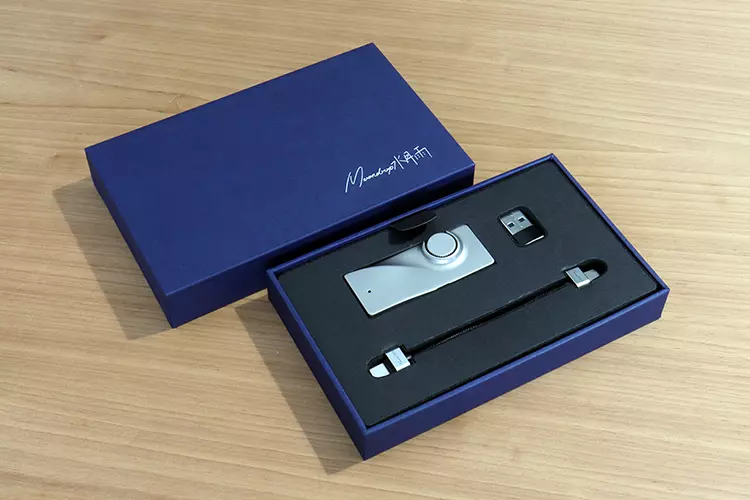
I found the included USB-C cable to be unique, and I heard it was made by ddHiFi, so it’s no wonder the cable has quirky square connectors. ddHiFi tends to think outside the box often.
The box size is generous, and the contents are safely placed inside. Of course, the box is decorated with some Waifu artwork, typical of MOONDROP.
Sound Impressions
One of the headphones I chose to use with the MOONDROP Monriver 3 is the HIFIMAN Sundara because of its popularity, medium efficiency level, and its familiar sonic signature. I also used the HEDD Audio HEDDphone D1 and the HIFIMAN Edition XV.
To test the MOONRIVER 3 with IEMs, I used the HIFIMAN Svanar, the FiiO FX17, and the Flare Audio Flare Studio to test for residual noise and hiss, and with the DSP mode off. The source used was my daily driver, a Motorola Edge, and my custom Windows 11 Pro PC.
Summary
The MOONDROP MOONRIVER 3 presents the sound to the listener as neutral, dynamic, and with very good resolution. It produces textures and detail that dongles of yesteryear were incapable of.
Its clean character produces a dark background with no hiss present, even when using a dirty USB output with no inline filters. I’m guessing the independent power input is partially responsible for such a low noise floor on the output side.
I used several IEMs, and the dark, silent background was persistent even though the MOONRIVER 3 doesn’t have a gain control, but it seems to do just fine without one.
I do detect a bright side to the sonic signature, which enhances detail, since the Monriver 3 produces lots of it and is perhaps one of the dongles that I’ve heard that is capable of producing such high levels of detail. I call it a sharp focus signature with an absence of coloration.
There’s also a presence aspect in the lower region that makes the bass sound rather full and poised, which never loses composure, or does it become boomy?
However, the midrange and bass response maintains good balance with the high frequencies, and no area of the frequency graph seems lacking or emphasized. It’s more of a reference tune than anything.
Bass is produced robustly with lots of body and enough energy to flourish with most headphones. The midrange is a neutral venture in that it is produced with a realistic tone above all else. The highs are clean and crisp.
The mids have a particular character in that they’re produced expansively without any loss in focus or accuracy as a consequence. What else can I say? Is it a well-composed dongle?
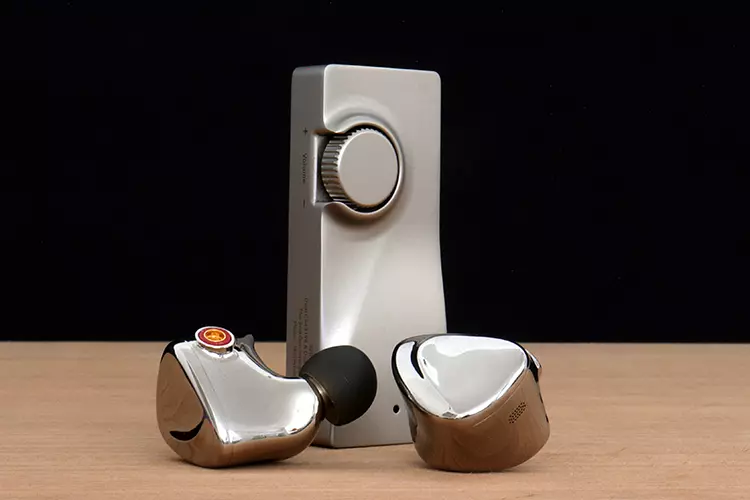
Staging & Dynamics
I have to admit that if I had to recommend a dongle to an audiophile who is looking for a wide, tall-sounding, and sometimes rear-projecting capable one, the MOONRIVER 3 will fit that bill nicely.
When I first heard the MOONRIVER 3, the tall, wide soundstage was the first thing I noticed. On occasion, it felt like a wrap-around sonic scape that was also capable of accurate microstaging.
The MONDROP MOONRIVER 3 produces what I consider a soundstage that doesn’t restrain itself to the confines of your head, and projects a lot of depth, height, along with an ability to circle the listener.
The MOONDROP MOONRIVER 3 is a technically capable dongle that shows this genre of audio gear is improving, not only in power delivery and increased dynamics, but in the overall precision in its soundstage and wide panoramic sonic picture creation capability.
Click on page 2 below for my recommended pairings and selected comparisons.
[ad_2]
Source link
Related Posts

Auribus Acoustics Sierra Review – Headfonia

Effect Audio Ares 10 Review — Headfonics

Grell OAE2 Review — Headfonics

PLUSSOUND Copper Fusion Hybrid Review — Headfonics

Beyerdynamic MMX 230 Headset Review: A New Gaming Champion!

Audeze Maxwell 2 Review – Headfonia

ThieAudio Hype 4 MKII Review

TWISTURA Beta Review — Headfonics

FiiO EH13 Review — Headfonics

The Auribus Acoustics Sierra Reference Headphones Review

Fosi Audio BT20A MAX Review — Headfonics


